

You see startups raising crores and wonder… how do they actually earn?
Most people think startups burn money forever. That’s half true.
But the smart ones build clear revenue models early.
In this guide, you’ll learn how Indian startups make money, with real examples you already know. No theory. Only practical breakdowns.
Quick Answer: How Indian Startups Make Money
- They charge users directly (subscriptions, fees, commissions)
- They take a cut from transactions (marketplaces, payments)
- They sell ads or user attention
- They earn from financial services (loans, insurance, investments)
- They use “freemium” models to convert free users to paid
What “Making Money” Means for a Startup
Startups don’t always focus on profit first.
They focus on:
- User growth
- Market capture
- Revenue streams later
But here’s the reality:
If they don’t figure out revenue, they die.
So every serious startup builds at least one strong revenue engine.
7 Real Ways Indian Startups Make Money (With Case Studies)
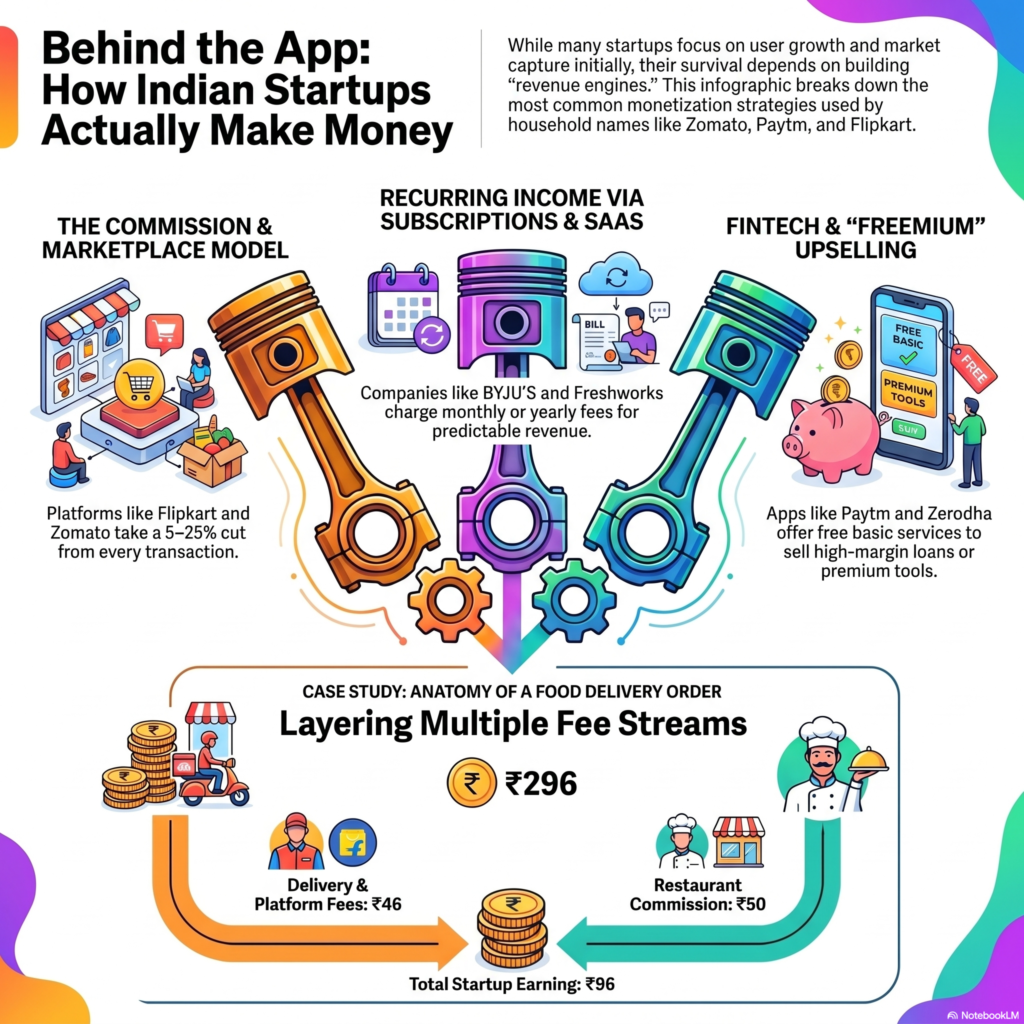
1. Commission-Based Model (Marketplace Cut)
What it is:
Startup takes a % from every transaction.
Why it works:
No inventory risk. Revenue grows with usage.
Example: Flipkart
- Sellers list products
- You buy using UPI/card
- Flipkart takes ~5–20% commission
Who should use this model:
Marketplace startups (e-commerce, services)
2. Subscription Model (Recurring Income)
What it is:
Users pay monthly or yearly fees.
Why it works:
Predictable revenue. High lifetime value.
Example: BYJU’S
- Offers learning content
- Charges subscription for premium courses
- Also upsells higher-priced programs
Reality check:
High refunds and customer complaints hurt them.
Subscription only works if value is real.
3. Delivery + Convenience Fees
What it is:
Charge users for convenience.
Example: Zomato / Swiggy
- Food cost: ₹300
- Delivery fee: ₹30–₹60
- Platform fee: ₹5–₹10
Plus:
- Commission from restaurants (15–25%)
Why it works:
Multiple revenue streams from one order.
4. Fintech Revenue (Loans, Insurance, Fees)
What it is:
Earn from financial products.
Example: Paytm
- Wallet + UPI = free for users
- Makes money from:
- Merchant fees
- Loan commissions
- Insurance sales
High CPC angle:
Loans and insurance bring huge margins.
5. Advertising Model
What it is:
Sell user attention to brands.
Example: ShareChat
- Free app
- Earns from ads shown in feed
Why it works:
Mass users = high ad revenue.
Problem:
Needs huge scale to work.
6. Freemium Model (Free → Paid Conversion)
What it is:
Basic features free, advanced features paid.
Example: Zerodha
- Free account opening (sometimes)
- Charges brokerage on trades
- Premium tools like “Kite Connect”
Why it works:
Low entry barrier → higher conversion.
7. SaaS (Software as a Service)
What it is:
Charge businesses monthly for software.
Example: Freshworks
- CRM tools for companies
- Monthly subscription per user
Why it works:
B2B customers pay more than individuals.
Real-Life Example (₹ Breakdown)
Let’s say you order food using Swiggy:
- Food: ₹250
- Delivery: ₹40
- Platform fee: ₹6
- Total paid: ₹296
Swiggy earns:
- ₹40 (delivery)
- ₹6 (platform fee)
- ~₹50 from restaurant commission
Total earning from one order: ~₹96
Now multiply by lakhs of orders daily.
That’s the business.
Common Mistakes People Make
- Thinking startups don’t earn at all
- Ignoring hidden fees (platform, convenience charges)
- Believing “free apps” are truly free
- Assuming valuation = profit
- Not understanding how user data is monetized
Pro Tips (Use This Knowledge Smartly)
- If a service is free, you are the product
- Look for hidden fees before using apps
- Prefer platforms with transparent pricing
- Avoid overpaying for convenience
- Invest in startups only after understanding revenue model
Practical Tools You Can Use
If you want to benefit from startup growth:
- Use platforms like Zerodha for investing in listed startups
- Track IPOs of companies like Zomato, Paytm
- Compare loan and insurance products carefully before buying
Don’t just use startups. Understand how they earn from you.
FAQ (SEO Section)
1. Do Indian startups make profit?
Most don’t initially. They focus on growth first, then profit.
2. What is the main revenue model for startups?
Commission, subscription, and fintech services are the most common.
3. How does Zomato make money?
Through delivery fees, restaurant commissions, and ads.
4. Are free apps really free?
No. They earn through ads, data, or upselling services.
5. Why do startups offer heavy discounts?
To acquire users quickly and dominate the market.
Conclusion
Indian startups don’t survive on funding alone.
They build strong money-making systems:
- Fees
- Commissions
- Subscriptions
- Financial products
Next time you use an app, ask one question:
“How is this company making money from me?”
That’s how you stop being just a user
and start thinking like an investor.