

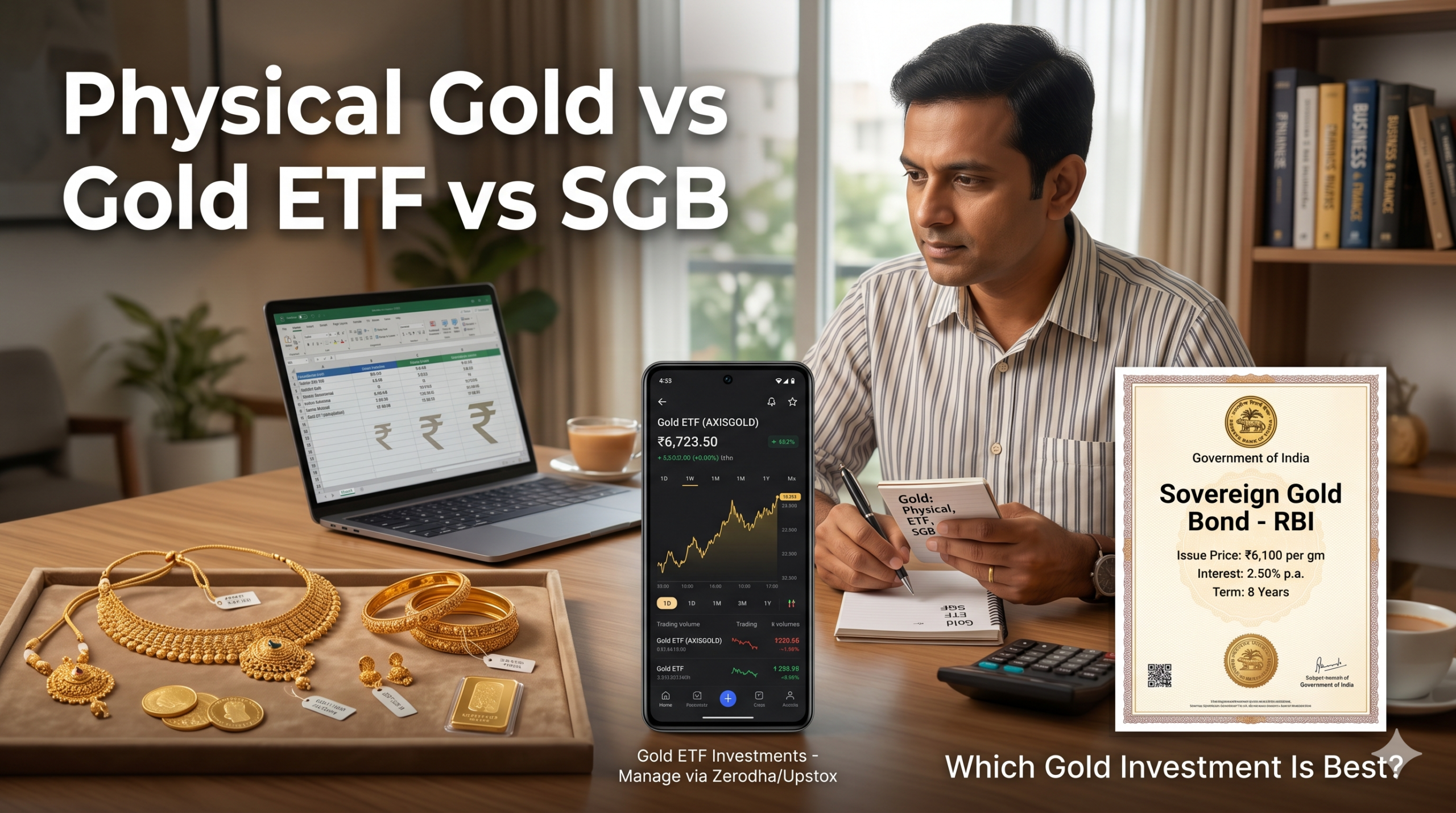
Gold is one of the most trusted investments in India. Every family buys it. Some buy for weddings. Some buy for safety. Others buy because “gold prices always go up.”
But most people never compare the different ways to invest in gold.
That’s where mistakes happen.
Many Indians still buy jewellery thinking it is a pure investment. In reality, making charges and resale cuts reduce profits badly.
Today, there are smarter options like Gold ETFs and Sovereign Gold Bonds (SGBs).
This guide explains Physical Gold vs Gold ETF vs SGB in simple terms so you can choose the right option for your money.
Quick Answer: Physical Gold vs Gold ETF vs SGB
- Physical gold is best for jewellery and traditional use.
- Gold ETF is best for flexible digital investing.
- SGB is best for long-term investors.
- SGB gives 2.5% yearly interest plus gold price growth.
- Physical gold has storage and making charge costs.
- Gold ETF is easier to buy and sell quickly.
For most salaried Indians, SGB gives the best long-term value.
What Is Gold Investment in India?
Gold investment means putting money into gold expecting future price growth.
In India, people use gold for:
- Wealth protection
- Emergency backup
- Wedding savings
- Inflation protection
- Long-term savings
But not every gold purchase is an investment.
Buying a gold necklace is very different from buying a Gold ETF or SGB.
That difference affects your returns.
Physical Gold vs Gold ETF vs SGB
1. Physical Gold
Physical gold includes:
- Jewellery
- Gold coins
- Gold bars
You buy it from jewellery stores, banks, or gold dealers.
Why Indians Still Prefer Physical Gold
- Easy to understand
- Emotionally valuable
- Useful during weddings
- Can be pledged for gold loans
Many families trust physical gold more than digital investments.
Problems With Physical Gold
Making Charges
Jewellery includes making charges.
Sometimes 10%–25% extra.
You rarely recover this fully during resale.
Storage Risk
Gold needs:
- Locker fees
- Safe storage
- Theft protection
Resale Deductions
Some jewellers reduce value during exchange.
Purity testing deductions are common.
Best For
- Wedding jewellery
- Traditional family savings
- People wanting physical ownership
Not Best For
- Pure investing
- Long-term wealth optimization
- Monthly SIP investing
2. Gold ETF
Gold ETF means Exchange Traded Fund.
It lets you invest in gold digitally through the stock market.
You need:
- Demat account
- Trading account
Gold ETF prices move with gold prices.
Popular investment platforms include:
Why Gold ETF Works Well
Easy Buying and Selling
You can buy or sell anytime during market hours.
No Storage Problems
No locker charges.
No theft risk.
Small Investment Possible
You can start with small amounts.
Good for beginners.
Downsides of Gold ETF
- No physical gold
- Expense ratio charges
- No interest income
- Requires demat account
Best For
- Young investors
- Salaried employees
- SIP investors
- People already investing in mutual funds or stocks
Not Best For
- Wedding savings
- Traditional physical ownership lovers
3. Sovereign Gold Bond (SGB)
SGB is issued by the Reserve Bank of India on behalf of the Government of India.
It tracks gold prices but also gives additional interest income.
That makes it different from regular gold investments.
Biggest Advantage of SGB
You earn from:
- Gold price increase
- 2.5% yearly interest
Very few gold investments offer both.
Major Benefits of SGB
No Storage Issues
Everything stays digital.
Tax Benefit
If held till maturity, capital gains are tax-free.
Government Backing
SGB is backed by the Government of India.
Extra Interest
Interest is paid every year.
Downsides of SGB
- Lock-in period
- Less liquidity compared to ETFs
- Not ideal for short-term needs
Best For
- Long-term investors
- Wealth preservation
- Conservative salaried investors
Not Best For
- Emergency fund needs
- Short-term trading
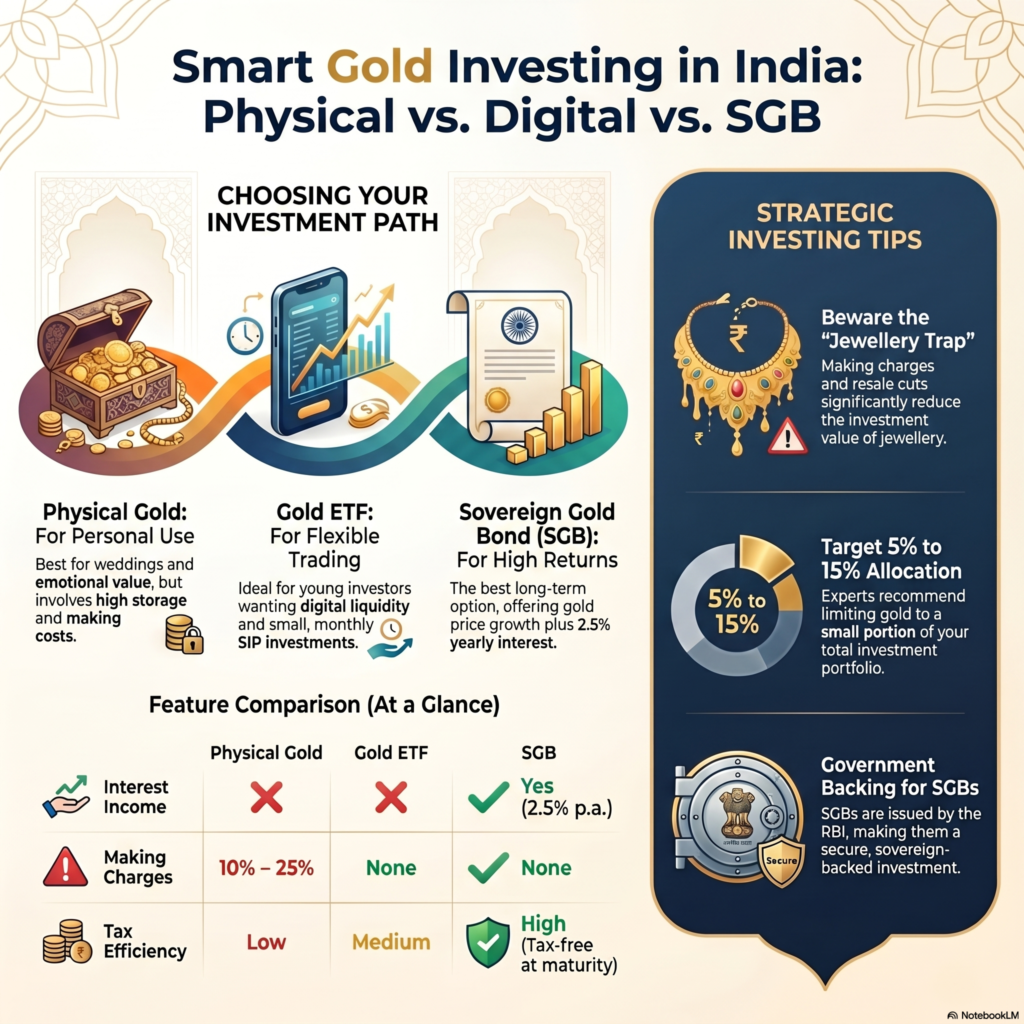
Physical Gold vs Gold ETF vs SGB Comparison Table
| Feature | Physical Gold | Gold ETF | SGB |
| Form | Jewellery/coins | Digital | Government bond |
| Storage Needed | Yes | No | No |
| Making Charges | High | None | None |
| Interest Income | No | No | Yes |
| Liquidity | Medium | High | Medium |
| Risk | Theft/purity | Market-linked | Government-backed |
| Tax Efficiency | Low | Medium | High |
| Best For | Personal use | Flexible investing | Long-term wealth |
Which Gold Investment Is Best in India?
Choose Physical Gold If
- You need jewellery later
- Your family values traditional gold ownership
- Emotional value matters
Choose Gold ETF If
- You want easy liquidity
- You prefer SIP investing
- You already use stock market apps
Choose SGB If
- You can invest for 5–8 years
- You want tax efficiency
- You want better long-term returns
For investment purposes, SGB usually wins.
Real-Life Indian Example
Arun lives in Chennai and earns ₹60,000 monthly.
Monthly expenses:
| Expense | Amount |
| Rent | ₹15,000 |
| Groceries | ₹9,000 |
| EMI | ₹6,000 |
| UPI bills | ₹5,000 |
| Family expenses | ₹10,000 |
| Savings left | ₹10,000 |
He wants gold exposure.
Scenario 1: Jewellery Purchase
He buys a ₹70,000 gold chain.
Around ₹8,000–₹12,000 goes into making charges.
That reduces investment efficiency.
Scenario 2: Gold ETF SIP
He starts ₹5,000 monthly Gold ETF SIP.
Easy to track.
Easy to sell anytime.
Scenario 3: SGB Investment
He invests ₹1 lakh in SGB.
He gets:
- Gold appreciation
- Interest income
- Better tax treatment
Over long periods, SGB usually gives better value.
Common Mistakes Indians Make With Gold Investment
1. Treating Jewellery as Pure Investment
Jewellery is partly lifestyle spending.
Not pure investing.
2. Ignoring Making Charges
Making charges silently reduce returns.
Many buyers ignore this completely.
3. Keeping Too Much Money in Gold
Gold protects wealth.
It does not create massive long-term growth like equities.
4. Buying During Hype
People rush to buy when prices spike.
That usually means buying expensive.
5. Not Checking Purity
Always check BIS hallmark certification.
Especially in local shops.
Pro Tips for Gold Investment in India
- Keep gold allocation between 5%–15% of portfolio.
- Use SGB for long-term wealth building.
- Use Gold ETF for flexible investing.
- Avoid heavy jewellery buying for investment purposes.
- Compare locker costs before buying physical gold.
Useful Platforms for Gold Investing
For Gold ETFs:
For SGB announcements:
For live gold price tracking:
FAQ: Gold Investment in India
Is SGB better than physical gold?
For long-term investment, usually yes. It avoids making charges and gives interest income.
Can I sell Gold ETF anytime?
Yes. You can sell during market hours through your demat account.
Is physical gold safer?
Physically yes. Financially, not always. Storage and resale costs reduce returns.
Which gold investment is best for beginners?
Gold ETF is easier for beginners already using investment apps.
SGB is better for long-term investors.
Is SGB completely risk-free?
Gold prices still fluctuate. But the bond itself is government-backed.
How much gold should Indians own?
Most experts suggest 5%–15% allocation in gold.
Conclusion
Gold remains one of India’s favorite investments for a reason.
But blindly buying jewellery is not smart investing anymore.
Physical gold gives emotional and practical value.
Gold ETF gives flexibility and convenience.
SGB gives the strongest long-term financial advantage for most Indians.
The right choice depends on your goal, time horizon, and liquidity needs.
Choose based on logic, not tradition alone.