


You finally decide to invest. Then confusion hits.
Everyone says “invest in stocks.” Others say “mutual funds are safer.”
You don’t want to lose money. But you also don’t want low returns.
So what’s actually safer for Indians?
This guide breaks it down clearly. No theory. Just what works in real life.
Quick Answer
Mutual Funds vs Direct Stocks — what’s safer?
- Mutual funds are safer for beginners due to diversification
- Direct stocks carry higher risk but can give higher returns
- Mutual funds need less time and knowledge
- Stocks require research, tracking, and emotional control
- For most Indians: start with mutual funds, then explore stocks
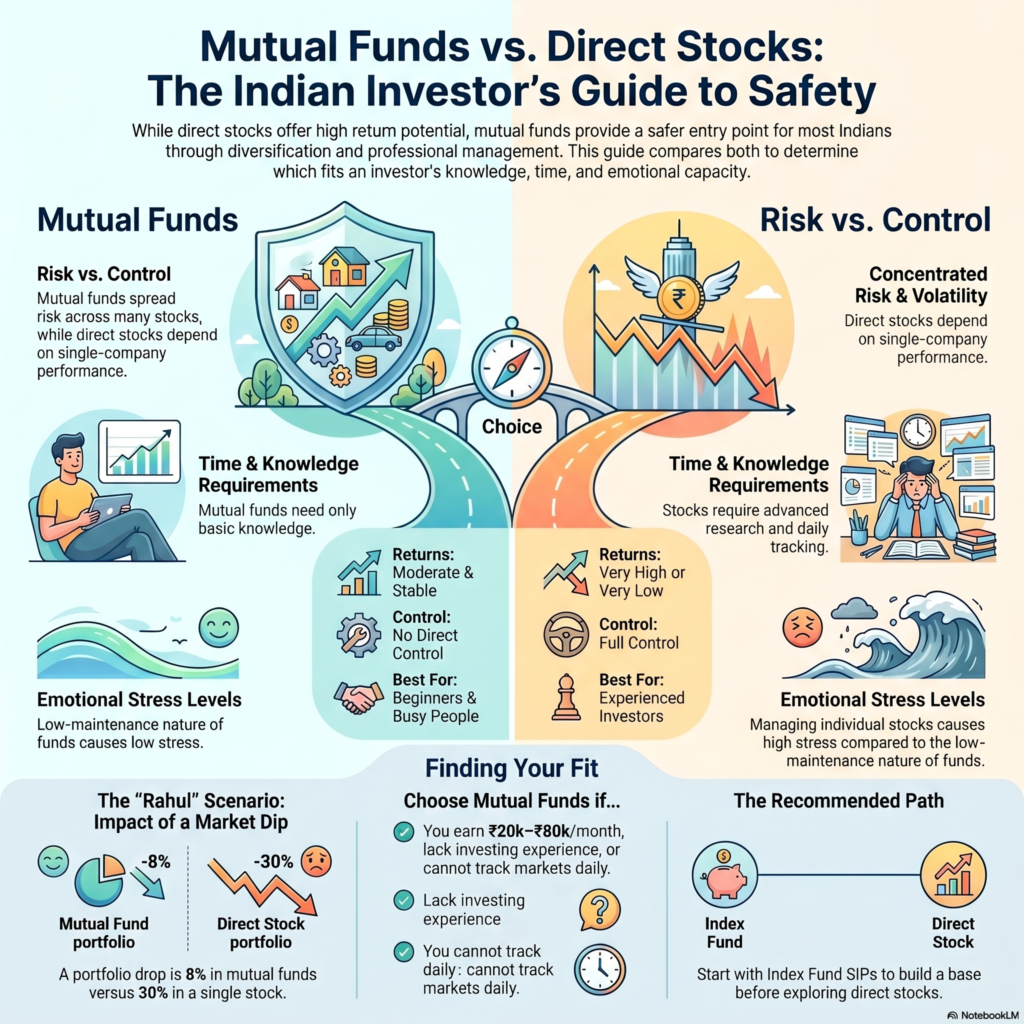
Before comparing, get this clear.
Mutual Funds:
You give money to a fund manager. They invest it for you.
Direct Stocks:
You buy shares of companies yourself.
That’s the core difference.
Mutual Funds vs Direct Stocks (Detailed Comparison)
| Factor | Mutual Funds | Direct Stocks |
| Risk | Lower (spread across many stocks) | High (depends on single stock) |
| Returns | Moderate but stable | Can be very high or very low |
| Time Needed | Low | High |
| Knowledge Needed | Basic | Advanced |
| Control | No direct control | Full control |
| Emotional Stress | Low | High |
| Best For | Beginners, busy people | Experienced investors |
Pros & Cons
Mutual Funds
Pros
- Diversification reduces risk
- Managed by experts
- SIP makes investing easy
- Good for long-term wealth
Cons
- Fund manager decisions affect returns
- Expense ratio reduces profit
- No control over stock selection
Direct Stocks
Pros
- Full control
- Higher return potential
- No management fees
- Good for skilled investors
Cons
- High risk
- Requires constant tracking
- Easy to make emotional decisions
- One bad stock can hurt badly
Who Should Choose What?
Choose Mutual Funds if:
- You earn ₹20k–₹80k/month
- You have no investing experience
- You can’t track markets daily
- You want steady growth
Choose Direct Stocks if:
- You understand business and markets
- You can handle losses mentally
- You have time to research
- You want aggressive returns
If you’re confused, you’re not ready for stocks yet.
Real-Life Example
Rahul earns ₹40,000/month in Chennai.
Expenses:
- Rent: ₹10,000
- Food: ₹6,000
- Travel: ₹3,000
- Others: ₹6,000
Savings: ₹15,000
Scenario 1: Direct Stocks
He invests ₹10,000 in one stock.
Stock crashes 30%.
Loss: ₹3,000
That hurts his monthly budget.
Scenario 2: Mutual Funds (SIP)
He invests ₹10,000 in 3 mutual funds.
Market falls.
Portfolio drops only 8%.
Loss: ₹800
Much easier to handle.
This is why mutual funds feel safer.
Common Mistakes
- Jumping into stocks after watching YouTube
- Investing in “hot tips” from friends
- Expecting quick returns
- Stopping SIP during market crash
- Putting all money in one stock
Most losses come from poor decisions, not bad markets.
Pro Tips
- Start with index funds or large-cap funds
- Use SIP instead of lump sum
- Learn before picking stocks
- Never invest emergency money
- Track investments once a month, not daily
Consistency beats smartness here.
Tools & Platforms
If you’re starting today, don’t overthink.
Use simple platforms like:
- Zerodha Kite (for stocks and mutual funds)
- Groww (easy for beginners)
- Paytm Money (simple SIP setup)
Start with SIP. Learn slowly. Then move to stocks.
FAQ Section
1. Is mutual fund safer than stocks in India?
Yes. Mutual funds spread risk across many stocks. Safer for beginners.
2. Can I lose money in mutual funds?
Yes. But losses are usually smaller than direct stocks.
3. Which gives higher returns?
Stocks can give higher returns. But also higher losses.
4. How much should I invest in mutual funds?
Start with ₹1,000–₹5,000 monthly SIP.
5. Can I do both mutual funds and stocks?
Yes. Start with funds. Add stocks later.
Conclusion
Mutual funds vs direct stocks is not about returns.
It’s about risk, time, and knowledge.
If you’re new, mutual funds are the safer choice.
Don’t rush into stocks to “get rich.”
Build a base first. Then take risks.
That’s how real wealth is built in India.