

Every year, the Union Budget is all over the news.
Tax changes, schemes, subsidies… it sounds complicated.
But here’s the truth:
It directly affects your salary, expenses, and savings.
If you ignore it, you lose money without realizing.
In this guide, you’ll understand the Union Budget in simple terms.
No jargon. Just what actually matters to you.
QUICK ANSWER
Union Budget explained for common people:
- It decides your income tax, subsidies, and benefits
- It impacts prices (fuel, food, electronics)
- It influences jobs, salaries, and investments
- It controls government spending and borrowing
- You should track tax changes and cost of living impact
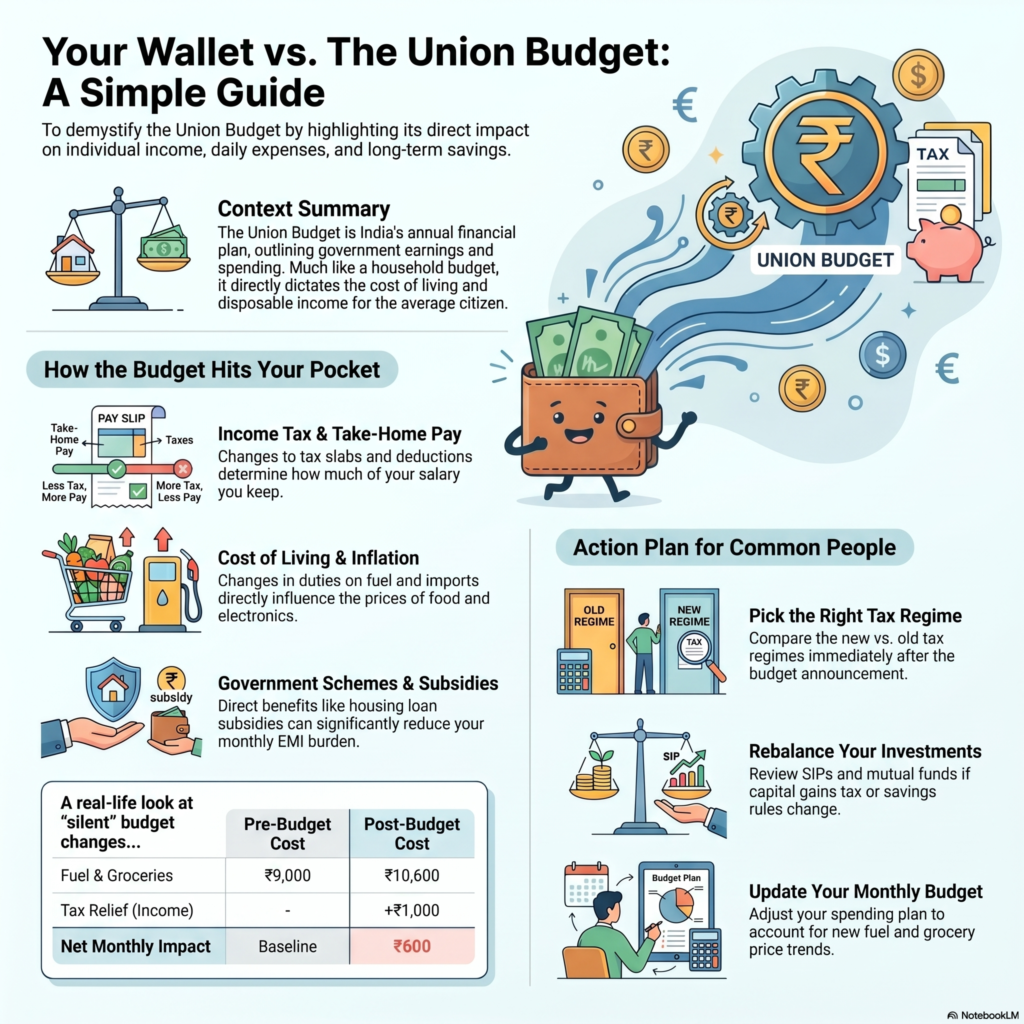
The Union Budget is India’s yearly financial plan.
It is presented by the Finance Minister.
It shows:
- How much the government will earn
- How much it will spend
- Where the money will go
Simple version:
It’s like your household budget, but for the country.
UNION BUDGET EXPLAINED FOR COMMON PEOPLE (WHAT REALLY MATTERS)
Let’s cut the noise.
These are the only parts that affect your daily life.
1. Income Tax Changes
What it is:
Changes in tax slabs, deductions, or exemptions.
Why it matters:
It decides how much salary you actually keep.
Example:
If tax slabs improve, your monthly income increases.
Action:
Check if the new tax regime or old regime suits you.
2. Cost of Living (Inflation Impact)
What it is:
Changes in duties on fuel, food, imports.
Why it matters:
Prices of daily items go up or down.
Example:
Higher fuel tax = higher transport + grocery cost.
Action:
Adjust your monthly budget after the budget.
3. Government Schemes & Subsidies
What it is:
Schemes for housing, education, farming, healthcare.
Why it matters:
You may get direct financial benefits.
Example:
Subsidies on housing loans reduce EMI burden.
Action:
Check eligibility for schemes every year.
4. Job & Business Growth
What it is:
Government spending on infrastructure, startups.
Why it matters:
More spending = more jobs and opportunities.
Example:
Infrastructure projects create jobs in construction.
Action:
Track sectors getting more budget allocation.
5. Investment & Savings Impact
What it is:
Changes in capital gains tax, savings schemes.
Why it matters:
Your investments can become more or less profitable.
Example:
Tax benefits on mutual funds increase returns.
Action:
Rebalance investments after budget changes.
REAL-LIFE EXAMPLE
Let’s say Ravi earns ₹40,000/month in Chennai.
Before Budget:
- Rent: ₹12,000
- Groceries: ₹6,000
- Fuel: ₹3,000
- EMI: ₹8,000
- Savings: ₹5,000
After Budget changes:
- Fuel price increases → ₹3,800
- Grocery prices rise → ₹6,800
- Tax relief gives ₹1,000 extra
New situation:
- Expenses increased by ₹1,600
- Income increased by ₹1,000
Net loss: ₹600/month
That’s how budgets silently hit your pocket.
COMMON MISTAKES
- Ignoring the budget completely
- Only focusing on tax, not expenses
- Not updating monthly budget
- Missing new government schemes
- Making emotional investment decisions
PRO TIPS
- Always check tax slab changes first
- Track fuel and food price changes
- Review SIPs after tax updates
- Use budget to identify growth sectors
- Adjust savings rate every year
If you want to actually use budget changes smartly:
- Track investments using apps like Zerodha or Groww
- Compare tax-saving options before choosing regime
- Use SIP calculators to adjust monthly investments
- Consider health and term insurance for tax benefits
Don’t just read the budget.
Use it to increase your net worth.
FAQ SECTION
1. What is Union Budget in simple words?
It is the government’s yearly plan for income and spending.
2. How does Union Budget affect common people?
It affects your taxes, expenses, job opportunities, and savings.
3. Should I change investments after every budget?
Not always. Only adjust if tax rules or returns change.
4. Why do prices increase after budget?
Due to changes in taxes, duties, and inflation factors.
5. Which part of budget should I focus on?
Focus on tax changes, inflation impact, and schemes.
6. Does budget affect salaried people more?
Yes. Salary, tax, and cost of living are directly impacted.
CONCLUSION
The Union Budget is not just a government document.
It’s a direct update to your financial life.
Ignore it, and you lose money silently.
Understand it, and you can stay ahead.
Track taxes. Adjust expenses. Use benefits.
That’s how you actually win with the budget.