

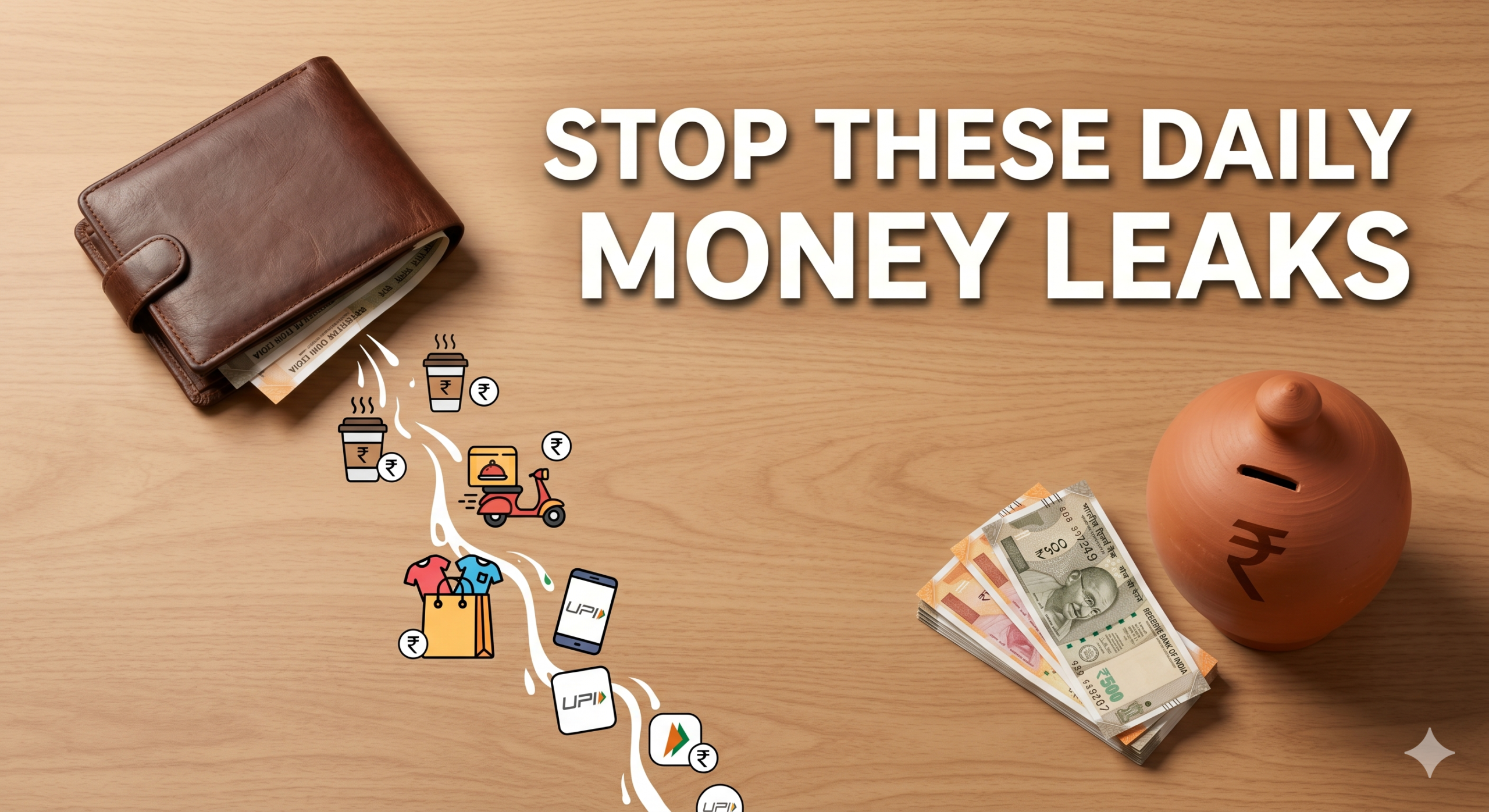
Money disappears fast.
UPI here, Swiggy there, random Amazon orders.
At the end of the month, you wonder where your salary went.
Here’s the truth:
You don’t need big sacrifices to save money.
You need small daily habits that actually stick.
In this guide, you’ll learn simple daily habits that save money in India — practical, realistic, and easy to follow.
QUICK ANSWER
Simple daily habits that save money in India:
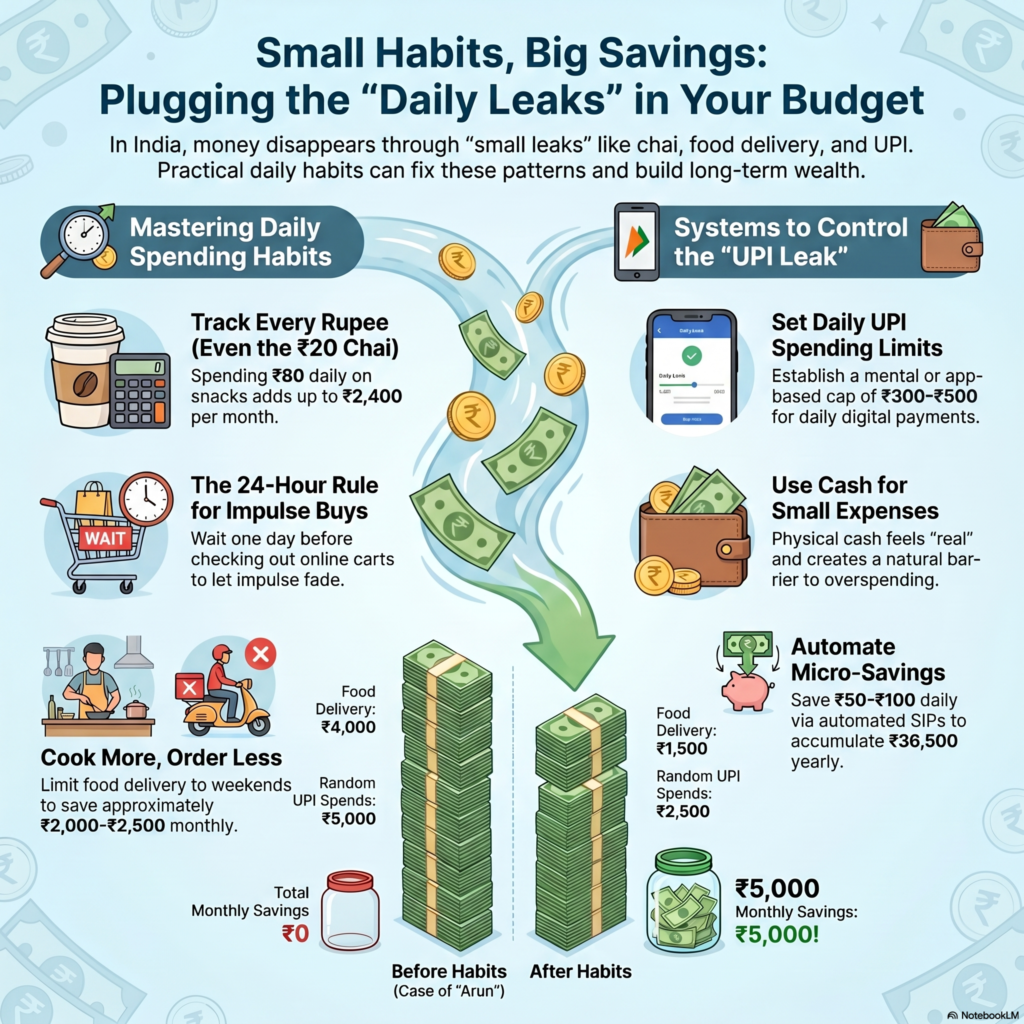
- Track every expense (even ₹20 chai)
- Cook more, order less
- Use UPI but set daily limits
- Delay non-essential purchases by 24 hours
- Automate small daily savings (₹50–₹100)
Saving money is not about big decisions.
It’s about daily behaviour.
Most Indians don’t overspend on luxury.
They lose money through small leaks.
Think:
- ₹150 coffee
- ₹300 food delivery
- ₹500 random online shopping
These habits quietly kill your savings.
Fix the daily pattern, money starts staying.
SIMPLE DAILY HABITS THAT SAVE MONEY IN INDIA
1. Track Every Rupee Daily
What it is:
Write down every expense.
Why it works:
You can’t fix what you don’t see.
Who should use it:
Everyone earning ₹10k to ₹1 lakh.
Example:
You spend ₹80 on tea + snacks daily.
That’s ₹2,400/month.
Action:
Use apps like Walnut or Money Manager
Or just use Notes app. No excuses.
2. Cook More, Order Less
What it is:
Reduce food delivery.
Why it works:
Food delivery is overpriced convenience.
Who should use it:
Anyone ordering more than 3 times/week.
Example:
₹300 per order × 15 days = ₹4,500/month
Home food cost: ₹2,000–₹2,500
Action:
Set rule: Order only on weekends.
3. Use UPI — But With Limits
What it is:
Set a daily spending cap.
Why it works:
UPI makes spending painless.
Who should use it:
People who “tap and pay” without thinking.
Example:
₹200 here, ₹150 there = ₹5,000 gone monthly.
Action:
Use apps like Google Pay or PhonePe
Set mental daily limit: ₹300–₹500.
4. Follow the 24-Hour Rule
What it is:
Wait before buying non-essentials.
Why it works:
Impulse fades. Logic returns.
Who should use it:
Online shoppers, especially Amazon addicts.
Example:
You see ₹999 headphones.
Wait 24 hours. You may not want it.
Action:
Add to cart. Don’t checkout immediately.
5. Carry Cash for Small Expenses
What it is:
Use physical cash for daily spending.
Why it works:
Cash feels real. UPI doesn’t.
Who should use it:
People overspending on small items.
Example:
₹200 cash/day = controlled spending
UPI = unlimited swipe
Action:
Withdraw weekly budget in cash.
6. Automate Daily Savings
What it is:
Save small amounts daily.
Why it works:
Consistency beats motivation.
Who should use it:
Beginners with low income.
Example:
₹100/day = ₹3,000/month
₹36,000/year
Action:
Use apps like Groww or Zerodha Coin
Start SIP or daily transfer.
7. Plan Tomorrow’s Spending Today
What it is:
Decide next day expenses in advance.
Why it works:
Reduces random spending.
Who should use it:
People with unstable daily expenses.
Example:
Decide: ₹200 max tomorrow.
You stay within limit.
Action:
Spend 2 minutes every night planning.
8. Avoid “Just One More” Purchases
What it is:
Control add-on spending.
Why it works:
Extra items inflate bills.
Who should use it:
Supermarket and online shoppers.
Example:
Went for milk. Bought snacks ₹300.
Action:
Go with a list. Stick to it.
REAL-LIFE EXAMPLE (INDIA)
Arun, Chennai — Salary ₹25,000/month
Before habits:
- Food delivery: ₹4,000
- Random UPI spends: ₹5,000
- Shopping: ₹3,000
- Savings: ₹0
After habits:
- Food delivery: ₹1,500
- Controlled UPI: ₹2,500
- Shopping reduced: ₹1,000
- Savings: ₹5,000
No income increase.
Only behaviour change.
COMMON MISTAKES
- Ignoring small expenses (“it’s just ₹50”)
- Depending on willpower instead of systems
- Trying extreme saving, then quitting
- Not tracking anything
- Using credit cards without discipline
PRO TIPS
- Use separate bank account for spending
- Delete shopping apps during weekdays
- Set auto-debit SIP on salary day
- Keep emergency fund in liquid fund
- Review expenses every Sunday
If you’re serious about saving:
- Start a SIP using Groww
- Track expenses with Walnut
- Open a zero-balance savings account for money separation
Small tools. Big impact.
FAQ SECTION
1. How much should I save daily in India?
Start with ₹50–₹100. Increase gradually.
2. Is UPI bad for saving money?
No. But it makes overspending easy.
3. Can small savings really matter?
Yes. ₹100/day = ₹36,500/year.
4. What’s the easiest habit to start?
Tracking expenses. It changes everything.
5. Should I stop eating outside completely?
No. Reduce frequency, don’t eliminate.
6. Which app is best for beginners?
Groww for investing, Walnut for tracking.
CONCLUSION
Saving money is not about earning more.
It’s about controlling daily behaviour.
Fix your habits, and your bank balance follows.
Start with one habit today.
Not five. Not ten.
One.
That’s how real change happens.