

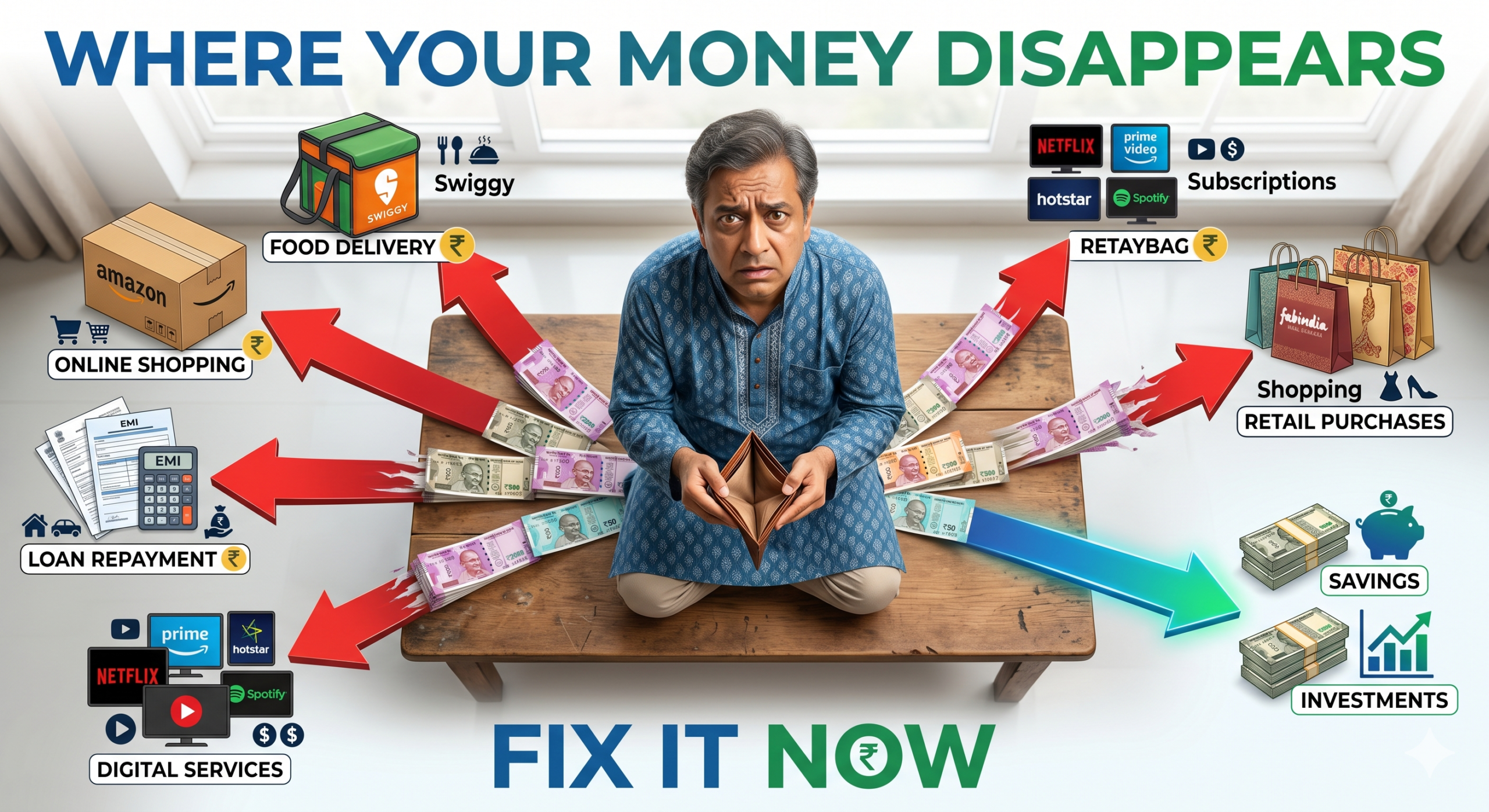
Money disappears fast.
Salary comes in, expenses eat it up.
Subscriptions, Swiggy orders, random Amazon buys. It all adds up.
Minimalist living in India fixes this problem. Not by cutting joy, but by cutting waste.
In this guide, you’ll learn how to spend less, save more, and still live well.
QUICK ANSWER
Minimalist living in India means spending only on what truly matters.
Here’s how to start:
- Track every rupee for 30 days
- Cut unused subscriptions and impulse buys
- Buy fewer, better-quality items
- Use UPI and cash limits to control spending
- Save first, spend what’s left
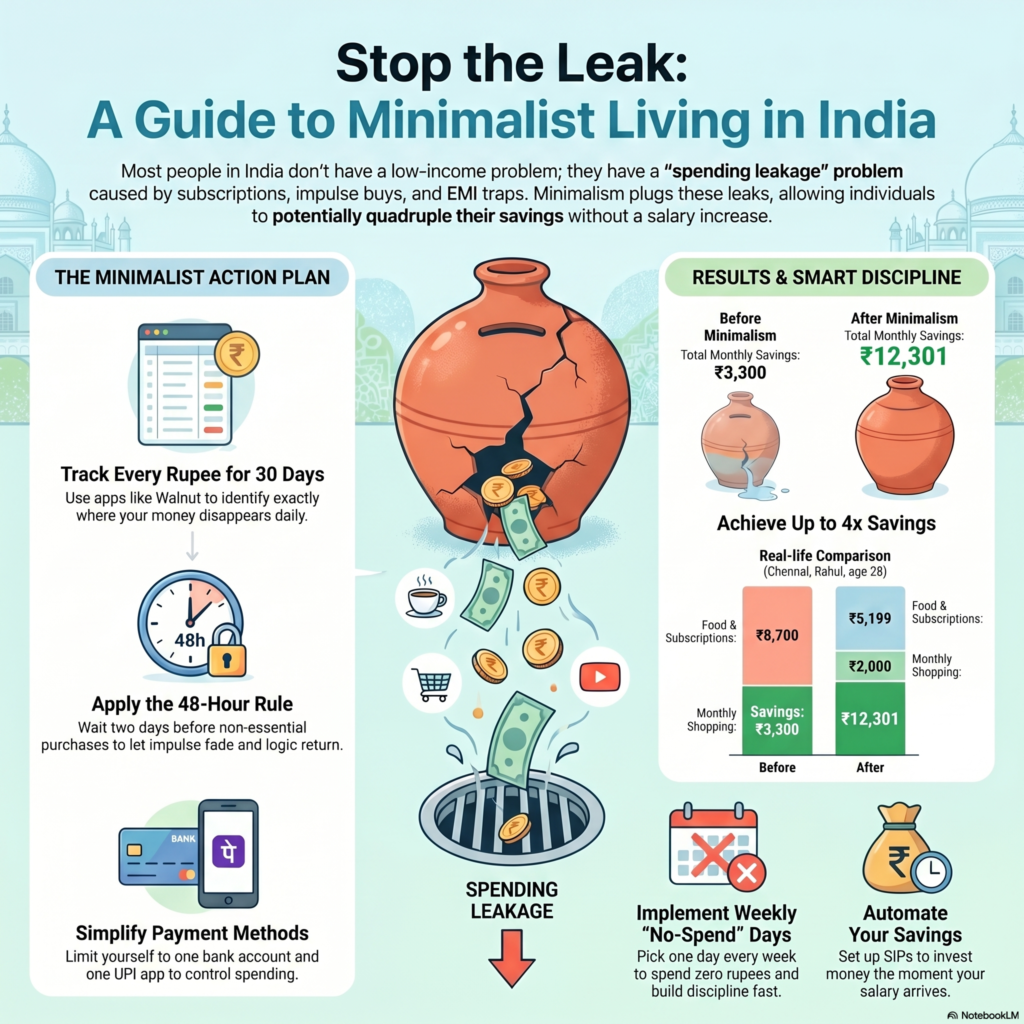
Minimalism is not about living poor.
It’s about removing useless spending.
In India, most people don’t have a low income problem.
They have a spending leakage problem.
Daily chai, online offers, EMI traps, lifestyle upgrades.
Minimalism plugs these leaks.
HOW TO START MINIMALIST LIVING IN INDIA (STEP-BY-STEP)
1. Track Every Expense for 30 Days
What it is:
Write down everything you spend.
Why it works:
You can’t fix what you don’t see.
Example:
₹120 chai + ₹300 Zomato + ₹499 subscription = ₹919 gone in one day.
Action:
Use apps like Walnut, Money Manager, or even Notes.
2. Kill Useless Subscriptions
What it is:
Cancel services you don’t use regularly.
Why it works:
Auto-debit hides spending pain.
Example:
Netflix ₹199 + Spotify ₹119 + Prime ₹149 = ₹467/month
That’s ₹5,600/year for mostly unused services.
Action:
Keep only one platform at a time.
3. Follow the “48-Hour Rule”
What it is:
Wait 48 hours before buying non-essential items.
Why it works:
Impulse fades. Logic returns.
Example:
That ₹2,999 headphone? After 2 days, you may not care.
Action:
Add items to cart. Don’t checkout immediately.
4. Buy Less, But Buy Better
What it is:
Choose quality over quantity.
Why it works:
Cheap items cost more long-term.
Example:
₹300 shoes replaced every 3 months vs ₹1,200 shoes lasting 2 years.
Action:
Avoid “offers”. Focus on durability.
5. Limit Payment Methods
What it is:
Reduce how many ways you can spend.
Why it works:
More options = more spending.
Example:
Credit card + UPI + Pay Later = dangerous combo.
Action:
Use one bank account and one UPI app.
6. Set a “No-Spend Day” Every Week
What it is:
One day where you spend ₹0.
Why it works:
Builds discipline fast.
Example:
No Swiggy, no shopping, no extras.
Action:
Pick Sunday or Monday and stick to it.
REAL-LIFE EXAMPLE (INDIAN SCENARIO)
Rahul, age 28, Chennai
- Salary: ₹35,000/month
Before Minimalism:
- Rent: ₹10,000
- Food & Swiggy: ₹8,000
- Subscriptions: ₹700
- Shopping: ₹5,000
- Transport: ₹3,000
- Misc: ₹5,000
Savings: ₹3,300
After Minimalist Living:
- Rent: ₹10,000
- Home food: ₹5,000
- Subscriptions: ₹199
- Shopping: ₹2,000
- Transport: ₹2,500
- Misc: ₹3,000
Savings: ₹12,301
That’s nearly 4x savings without increasing income.
COMMON MISTAKES
- Cutting essentials instead of luxuries
- Going extreme and quitting everything
- Following trends like “no-buy year” blindly
- Ignoring small daily expenses
- Using credit cards without discipline
PRO TIPS
- Automate savings using SIPs before spending
- Use UPI history weekly to review expenses
- Keep a fixed monthly “fun money” budget
- Avoid EMI unless it’s for assets
- Declutter your room. It changes spending habits
TOOLS & PLATFORMS
If you want this to actually work, use tools:
- Expense tracking apps (Walnut, Money Manager)
- SIP platforms (Groww, Zerodha Coin)
- High-interest savings accounts (for emergency fund)
- Term insurance to protect income
Start small. Even ₹2,000 monthly SIP builds discipline.
FAQ SECTION
1. Is minimalist living practical in India?
Yes. It works better in India due to lower fixed costs and flexible lifestyle.
2. How much can I save with minimalism?
Most people save 20%–40% more within 2–3 months.
3. Does minimalism mean no enjoyment?
No. It removes waste, not happiness.
You still spend, but with purpose.
4. Should I stop using credit cards?
Not necessary. But avoid EMI traps and pay full bill monthly.
5. Can families follow minimalist living?
Yes. It works well for families by reducing unnecessary household spending.
CONCLUSION
Minimalist living in India is not about sacrifice.
It’s about control.
Track your money. Cut waste. Keep what matters.
Do this right, and your income won’t feel small anymore.