

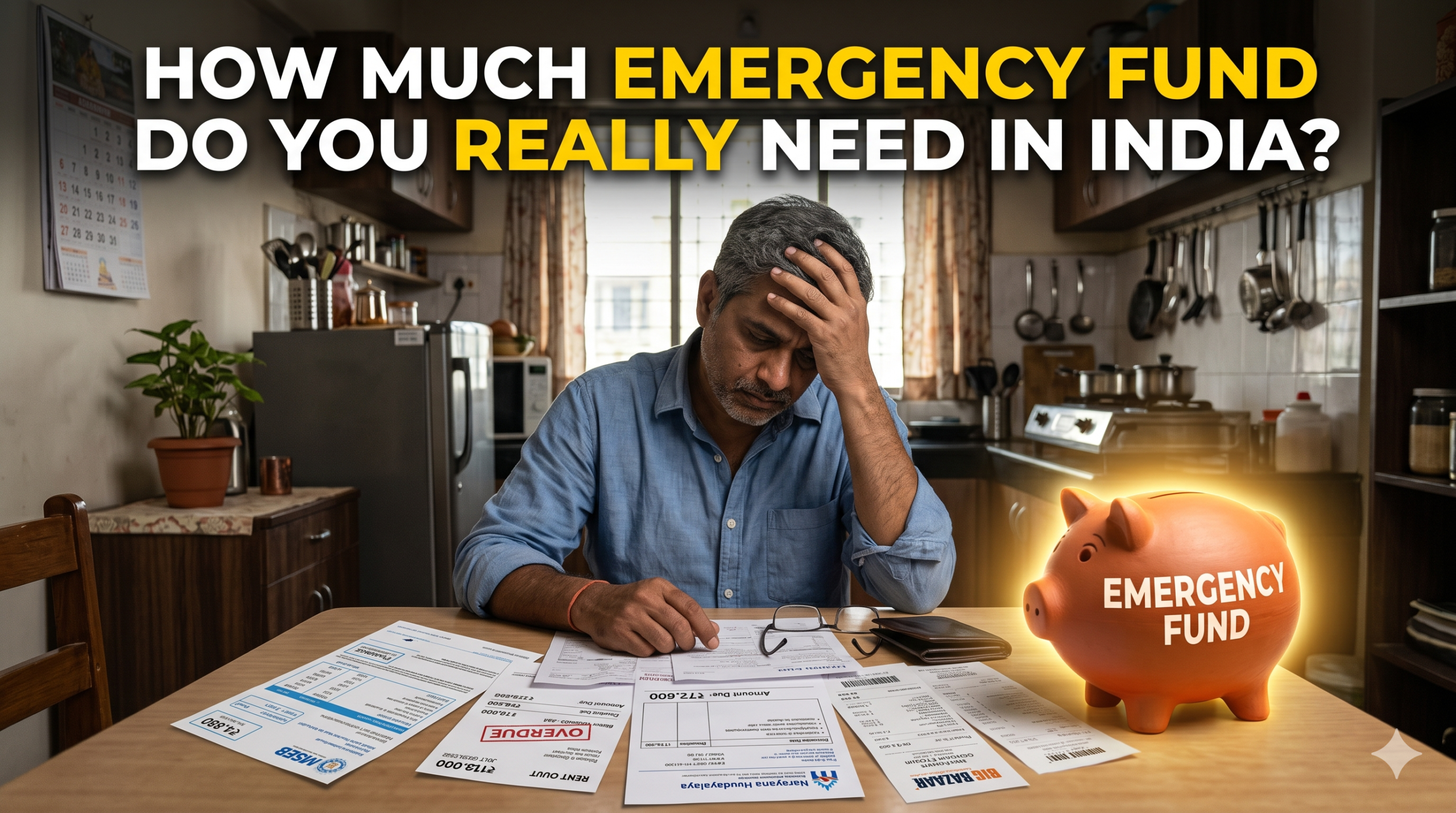
One unexpected expense can break your entire budget.
Hospital bill. Job loss. Family emergency.
Most people in India don’t have backup money. They rely on credit cards or loans. That’s expensive and risky.
So how much emergency fund do you actually need?
Not theory. Not “6 months blindly.”
Let’s break it down with real Indian numbers and a simple method.
QUICK ANSWER
How much emergency fund you need in India:
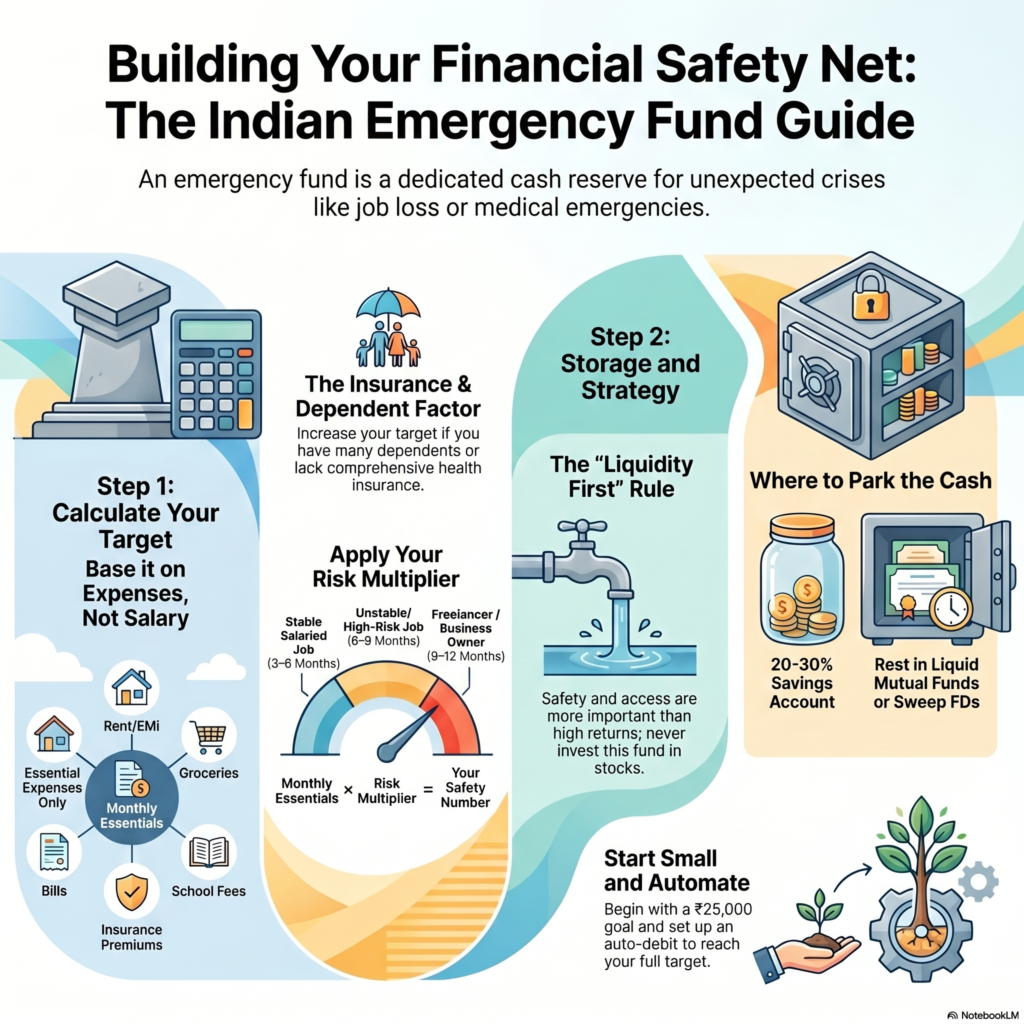
- Minimum: 3 months of essential expenses
- Safe level: 6 months of essential expenses
- Risky job / freelancer: 9–12 months
- Dual income family: 3–4 months may be enough
- Always calculate based on expenses, not salary
An emergency fund is money you keep aside for unexpected situations.
Not for vacations. Not for gadgets.
Only for:
- Job loss
- Medical emergencies
- Urgent home repairs
This money must be:
- Easy to access
- Safe (no risk)
- Separate from your main account
HOW TO CALCULATE YOUR EMERGENCY FUND (STEP-BY-STEP)
Step 1: Calculate Essential Monthly Expenses
Don’t include luxuries.
Only count what you must pay to survive.
Include:
- Rent / EMI
- Groceries
- Electricity + mobile bills
- School fees
- Basic transport
- Insurance premiums
Example:
- Rent: ₹12,000
- Groceries: ₹8,000
- Bills: ₹3,000
- Transport: ₹2,000
- Insurance: ₹2,000
Total = ₹27,000
Action: Write your actual monthly essentials.
Step 2: Multiply by Risk Level
Now choose based on your situation:
- Stable job → × 3 to 6
- Unstable job → × 6 to 9
- Freelancer/business → × 9 to 12
Example:
₹27,000 × 6 = ₹1,62,000
Action: Pick a number that matches your job stability.
Step 3: Adjust for Dependents
More dependents = higher risk.
- Single → lower fund
- Married → moderate
- Kids + parents → higher fund
Example:
If family depends on you → aim for 6–9 months minimum.
Action: Increase your fund if others depend on your income.
Step 4: Factor Insurance (Critical Shortcut)
If you have:
- Health insurance
- Term insurance
Your emergency fund burden reduces.
Without insurance, your emergency fund must be higher.
Action: If uninsured, increase target by at least 2–3 months.
Step 5: Decide Where to Keep It
Don’t invest emergency money in risky assets.
Use:
- Savings account
- Liquid mutual funds
- Sweep FD
Rule: Liquidity > returns
REAL-LIFE EXAMPLE (INDIAN SCENARIO)
Rahul works in Chennai. Salary: ₹45,000.
Monthly essentials:
- Rent: ₹10,000
- Food: ₹7,000
- Bills: ₹3,000
- Transport: ₹2,500
- Insurance: ₹2,500
Total: ₹25,000
He has a stable job.
So he chooses 6 months.
Emergency fund = ₹25,000 × 6 = ₹1,50,000
He builds it slowly:
- Saves ₹10,000/month
- Reaches goal in 15 months
No stress. No loans.
COMMON MISTAKES
1. Using salary instead of expenses
Wrong base. You inflate your target unnecessarily.
2. Investing emergency fund in stocks
Market crash + emergency = disaster.
3. Keeping everything in one account
Easy to spend accidentally.
4. Ignoring insurance
One hospital bill can wipe out savings.
5. Waiting to “start later”
Emergencies don’t wait for your plan.
PRO TIPS
- Start with ₹25,000. Don’t wait for perfect amount
- Automate savings monthly
- Keep 20–30% in savings account, rest in liquid fund
- Increase fund when income increases
- Recalculate every year
TOOLS & PLATFORMS
To build your emergency fund faster, use:
- Auto-debit savings in your bank
- Liquid funds via platforms like Groww or Zerodha Coin
- High-interest savings accounts from banks like ICICI or HDFC
If you don’t have insurance yet, fix that first.
Emergency fund + insurance = real safety.
FAQ SECTION
1. Is 3 months emergency fund enough in India?
Yes, but only for very stable jobs. Otherwise, aim for 6 months.
2. Where should I keep my emergency fund?
Savings account + liquid mutual funds. Avoid stocks or crypto.
3. Can I use FD for emergency fund?
Yes, but use sweep-in FD for quick access.
4. Should I build emergency fund or invest first?
Emergency fund comes first. Investing comes after.
5. How long does it take to build an emergency fund?
Depends on savings rate. Usually 6–18 months.
6. What if I have debt?
Build a small emergency fund (₹25k–₹50k), then focus on debt.
CONCLUSION
Your emergency fund is not a random number.
It’s based on your expenses, job risk, and responsibilities.
For most people in India:
6 months of essential expenses is the sweet spot.
Start small. Stay consistent.
Because when things go wrong, this fund decides whether you panic… or stay in control.