


Saving ₹5 lakhs is not a small achievement.
Most people either leave it in a savings account or put everything into one investment. Both are mistakes.
A good ₹5 lakh investment plan in India depends on three things:
- Your emergency needs
- Your risk tolerance
- Your financial goals
If used properly, ₹5 lakhs can create monthly income, long-term wealth, or financial security. This guide shows a practical investment plan for Indian beginners without confusing finance jargon.
Quick Answer: Best Investment Plan for ₹5 Lakhs in India
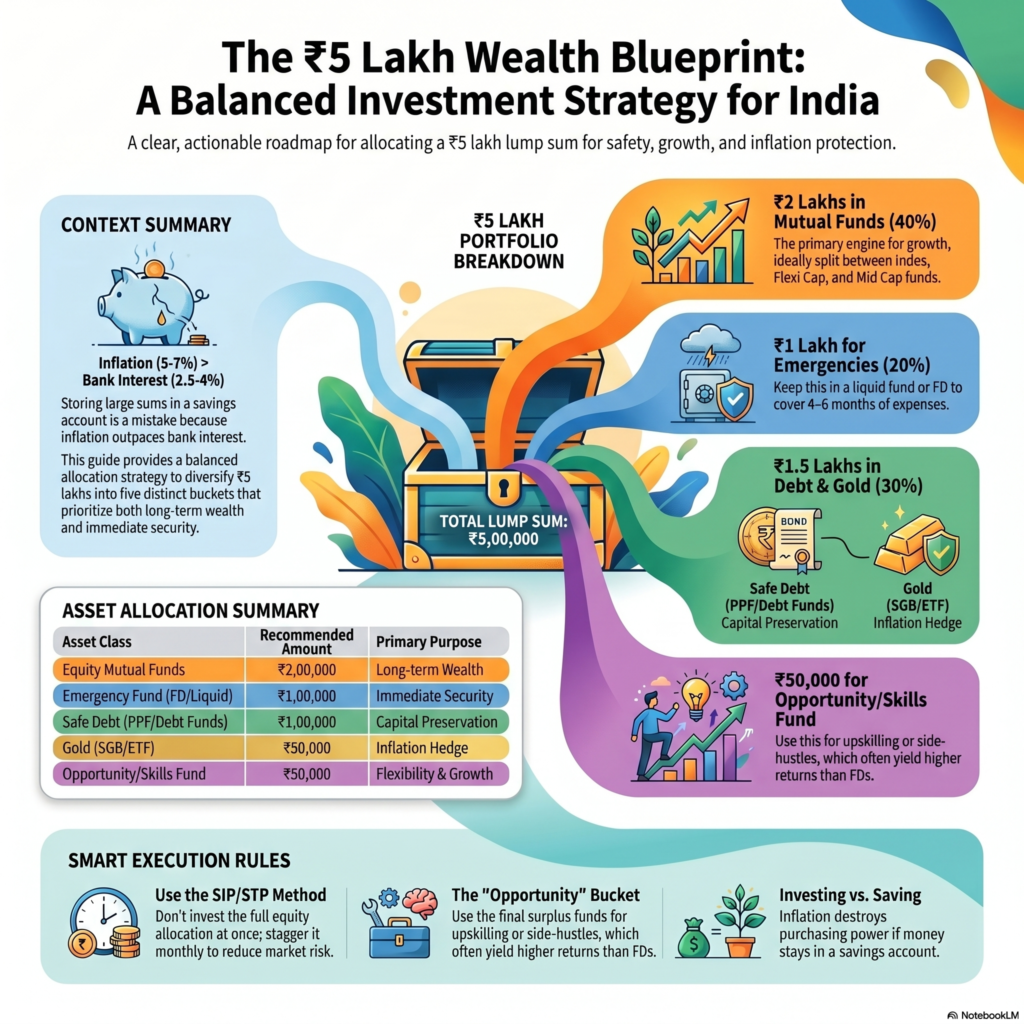
Here’s a balanced investment allocation for most Indians:
- ₹1 lakh → Emergency fund in FD or liquid fund
- ₹2 lakhs → SIP + index mutual funds
- ₹1 lakh → Debt investments like PPF or short-term debt funds
- ₹50,000 → Gold ETF or Sovereign Gold Bonds
- ₹50,000 → High-growth or flexible investments
This plan balances:
- Safety
- Growth
- Liquidity
- Inflation protection
Best for:
- Salaried employees
- Beginners
- Middle-class families
- First-time investors
Why You Should Not Keep ₹5 Lakhs in Savings Account
Many Indians leave large savings in bank accounts.
That feels safe. But inflation quietly destroys the value.
Example:
- Savings account interest: 2.5%–4%
- Inflation in India: 5%–7%
Your money grows slower than expenses.
After 10 years, your purchasing power drops heavily.
That is why smart allocation matters more than simply saving money.
Best Investment Plan for ₹5 Lakhs in India
1. Keep ₹1 Lakh as Emergency Fund
What it is
Money for emergencies:
- Job loss
- Medical expenses
- Family emergencies
- Sudden repairs
Why it works
You avoid:
- Personal loans
- Credit card debt
- Breaking investments early
Where to keep it
Choose:
- High-interest savings account
- Liquid mutual fund
- Fixed deposit
Who should do this
Everyone.
No exceptions.
Action Step
Keep at least 4–6 months of expenses ready.
If your monthly expenses are ₹25,000:
- Emergency fund needed = ₹1–1.5 lakhs
2. Invest ₹2 Lakhs in Mutual Funds
This is where long-term wealth gets created.
Split Example
| Fund Type | Amount |
| Index Fund | ₹1,20,000 |
| Flexi Cap Fund | ₹50,000 |
| Mid Cap Fund | ₹30,000 |
Why Mutual Funds Work
- Professional management
- Better returns than FD
- Good for long-term investing
- Easy SIP options
Historically, quality equity mutual funds gave around 10%–14% annual returns over long periods.
Best Strategy
Do not invest entire ₹2 lakhs in one day.
Use STP or SIP method.
Example:
- Invest ₹25,000 monthly for 8 months
This reduces market timing risk.
Who Should Use Mutual Funds
Best for:
- Salaried employees
- Young investors
- People investing for 5+ years
Not ideal if:
- You panic during market falls
3. Put ₹1 Lakh in Safe Debt Investments
Not all money should chase high returns.
You need stability too.
Good Options
| Investment | Returns | Lock-in | Risk |
| PPF | 7%–8% | 15 years | Very low |
| FD | 6%–7% | Flexible | Low |
| Debt Mutual Funds | 6%–8% | Flexible | Moderate |
Best Choice for Beginners
- PPF for long-term safety
- FD for short-term goals
- Debt funds for tax efficiency
Action Step
If you already have EPF through salary:
- Use debt mutual funds or FD for diversification
4. Invest ₹50,000 in Gold
Gold is not for fast growth.
Gold is protection.
When markets crash or inflation rises, gold often performs well.
Best Gold Investments in India
Avoid heavy jewellery purchases.
Better options:
- Sovereign Gold Bonds (SGB)
- Gold ETF
- Digital gold only from trusted apps
Why Gold Helps
- Diversifies portfolio
- Reduces overall risk
- Useful during economic uncertainty
5. Keep ₹50,000 for Opportunities
This part gives flexibility.
Use it for:
- Business ideas
- Skill courses
- Stocks
- Side hustle setup
- REITs
- Travel or career upgrades
Most people ignore this.
But improving income potential often gives better returns than investments.
A ₹20,000 skill course can increase salary faster than an FD ever will.
Real-Life Example: ₹5 Lakh Investment Plan for an Indian Salaried Employee
Rahul is 29 years old.
Monthly salary: ₹55,000
Monthly expenses: ₹28,000
Existing savings: ₹5 lakhs
Here’s his allocation:
| Investment | Amount |
| Emergency FD | ₹1,20,000 |
| Index Mutual Funds | ₹1,50,000 |
| Flexi Cap Fund | ₹50,000 |
| PPF | ₹80,000 |
| Gold ETF | ₹50,000 |
| Skill Upgrade + Cash | ₹50,000 |
Expected outcome after 10 years:
- Potential portfolio value: ₹11–15 lakhs+
- Better financial security
- Lower debt risk
This assumes regular SIP continuation.
Common Mistakes People Make With ₹5 Lakhs Savings
Investing Everything in One Place
Many put all money into:
- FD
- Gold
- One stock
- One crypto coin
That is risky and inefficient.
Keeping Too Much Cash
Too much idle money loses value yearly because of inflation.
Chasing “Double Money” Schemes
If someone promises:
- Guaranteed high returns
- Fast profits
- No risk
Assume it is dangerous.
Buying Insurance as Investment
Traditional LIC-type plans often give poor returns.
Insurance and investing should usually stay separate.
Ignoring Taxes
Tax affects actual returns.
Always check:
- Capital gains tax
- FD taxation
- Debt fund taxation
Pro Tips for Investing ₹5 Lakhs Smartly
- Increase SIP yearly with salary hikes
- Use index funds if confused
- Avoid random stock tips from social media
- Review portfolio once every 6 months
- Keep investments simple
Complex portfolios usually perform worse for beginners.
Best Platforms and Apps for Investing in India
These platforms are beginner-friendly:
For fixed deposits:
Before investing:
- Compare charges
- Check lock-in periods
- Understand taxation
FAQ: ₹5 Lakhs Investment Plan India
Can I retire with ₹5 lakhs investment?
No.
₹5 lakhs alone is not enough for retirement in India.
But it is a strong starting point.
Is FD better than mutual funds?
FD is safer.
Mutual funds usually offer better long-term growth.
Both serve different purposes.
How much return can ₹5 lakhs generate?
Depends on allocation.
A balanced portfolio may generate:
- 8%–12% yearly average over long periods
Not guaranteed.
Should I invest lump sum or SIP?
For beginners:
- SIP or staggered investing is safer
Especially during volatile markets.
Is gold necessary in portfolio?
Not mandatory.
But 5%–10% gold allocation helps diversification.
Which mutual fund is best for beginners?
Index funds are usually easiest.
They are:
- Low-cost
- Simple
- Less dependent on fund managers
Conclusion
The best investment plan for ₹5 lakhs in India is not about finding one “perfect” investment.
It is about balance.
Keep some money safe.
Invest some for growth.
Protect against emergencies.
And improve your earning power.
A simple portfolio beats a complicated one for most people.
Do not chase fast returns.
Focus on:
- Consistency
- Diversification
- Long-term investing
That is what actually builds wealth in India.