

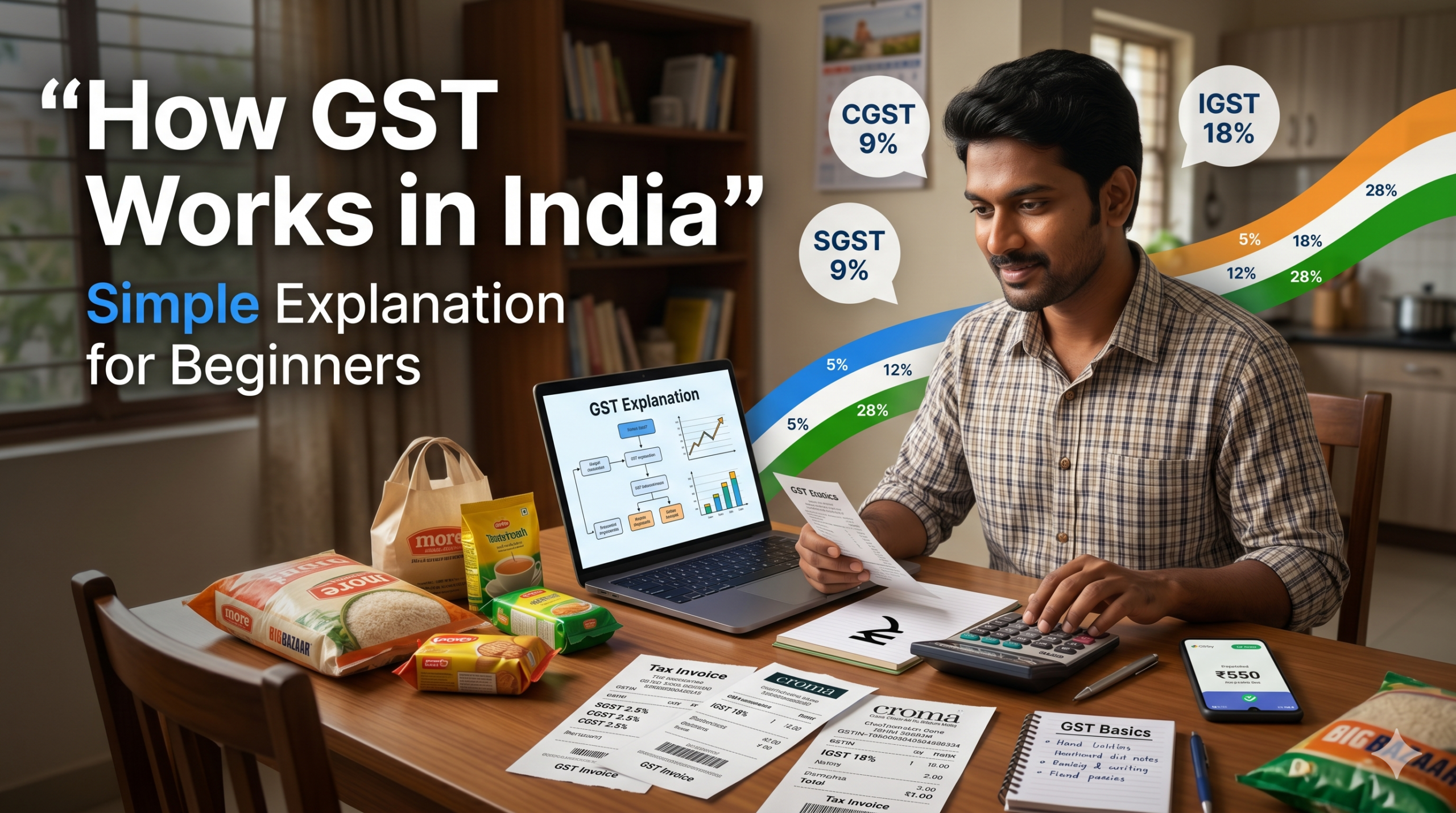
Most people pay GST daily without fully understanding it.
You pay GST while ordering food, buying clothes, recharging your phone, or booking a cab. But many Indians still get confused about CGST, SGST, IGST, tax slabs, and GST bills.
This guide explains how GST works in India in simple language.
You’ll learn:
- What GST actually means
- How GST is charged
- Different GST types
- Real-life examples with ₹ calculations
- Common mistakes people make
By the end, GST will finally make sense.
Quick Answer: How GST Works in India
- GST stands for Goods and Services Tax.
- It is an indirect tax charged on products and services.
- Businesses collect GST from customers and pay it to the government.
- GST replaced older taxes like VAT, service tax, and excise duty.
- GST has different slabs: 5%, 12%, 18%, and 28%.
Example:
If a product costs ₹1,000 and GST is 18%:
- GST amount = ₹180
- Final price = ₹1,180
That’s the basic idea.
What Is GST in India?
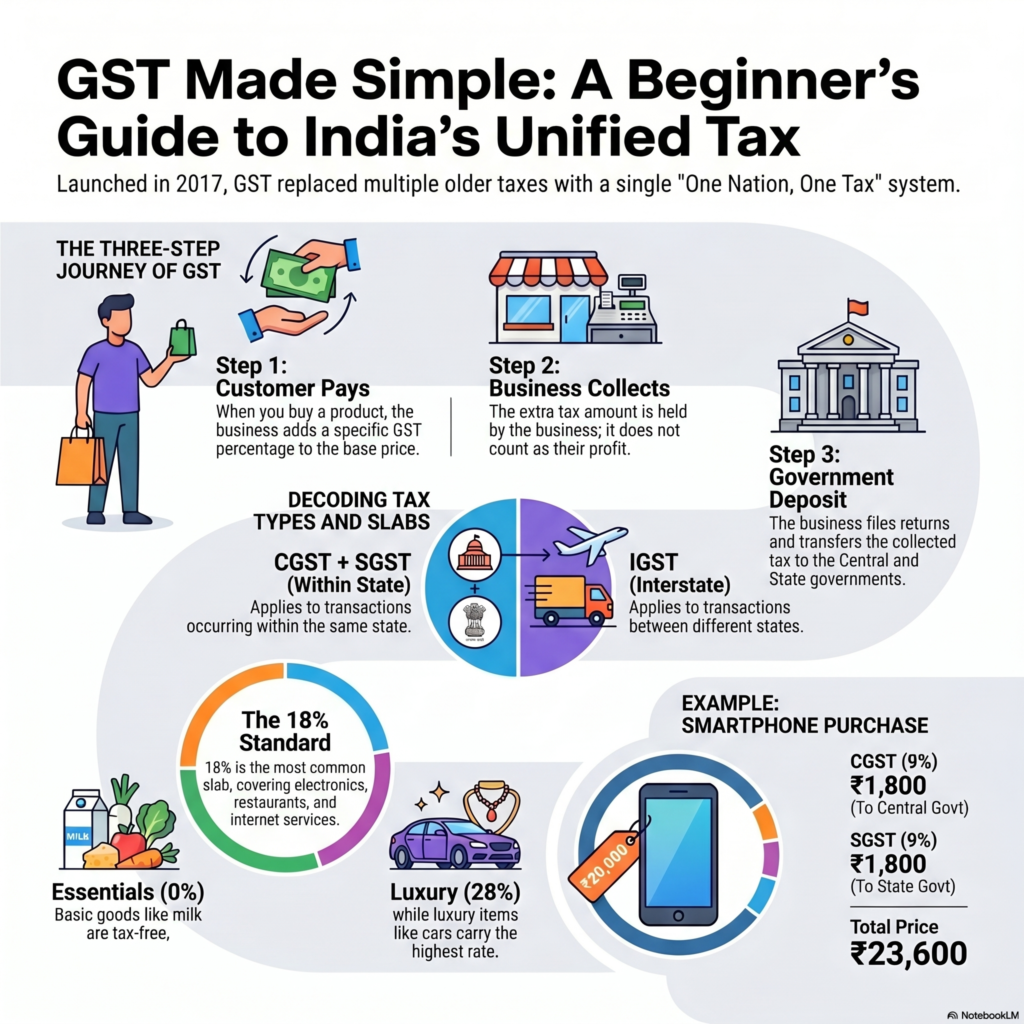
GST is a single tax system introduced in India in 2017.
Before GST, India had many separate taxes:
- VAT
- Service Tax
- Excise Duty
- Entry Tax
- Luxury Tax
This created confusion and double taxation.
GST combined most of them into one system.
Today, whether you buy a laptop, eat at a restaurant, or use an app subscription, GST usually applies.
How GST Works in India Step by Step
Step 1: A Business Sells a Product
Suppose a shop sells headphones for ₹2,000.
GST rate = 18%.
The business adds GST to the price.
Calculation:
- Product price = ₹2,000
- GST = ₹360
- Final bill = ₹2,360
You pay ₹2,360.
Step 2: Business Collects GST
The extra ₹360 does not belong to the shop owner.
The shop collects it for the government.
This is why GST is called an indirect tax.
Customers pay it indirectly.
Step 3: Business Pays GST to Government
The business files GST returns online.
Then it deposits collected GST to the government.
This process happens monthly or quarterly.
Types of GST in India
This is where beginners get confused.
There are mainly 3 GST types.
1. CGST (Central GST)
The Central Government receives this tax.
2. SGST (State GST)
The State Government receives this tax.
3. IGST (Integrated GST)
Used for interstate transactions.
Meaning:
- Seller and buyer are in different states.
How CGST and SGST Work
Suppose you buy a phone in Tamil Nadu.
Phone price = ₹20,000
GST rate = 18%
GST gets split equally.
| Tax Type | Amount |
| CGST (9%) | ₹1,800 |
| SGST (9%) | ₹1,800 |
| Total GST | ₹3,600 |
Final price = ₹23,600
How IGST Works
Suppose a Delhi seller ships a laptop to Chennai.
GST rate = 18%.
Instead of CGST + SGST, only IGST applies.
| Tax Type | Amount |
| IGST (18%) | ₹9,000 |
If laptop price = ₹50,000:
- Final amount = ₹59,000
GST Slabs in India
Different products have different GST rates.
0% GST
Basic essentials:
- Fresh vegetables
- Milk
- Eggs
5% GST
Daily-use items:
- Packaged food
- Railway tickets
12% GST
Some processed products:
- Butter
- Mobiles in some categories
18% GST
Most common slab:
- Electronics
- Restaurant bills
- Shampoo
- Internet services
28% GST
Luxury items:
- Luxury cars
- Premium bikes
- Some appliances
Why GST Matters for Normal People
Many people think GST only affects businesses.
Wrong.
GST affects:
- Your monthly expenses
- Restaurant bills
- Insurance premiums
- Mobile recharge
- OTT subscriptions
- Online shopping
Even your health insurance and term insurance include GST.
Example:
- Insurance premium = ₹20,000
- GST at 18% = ₹3,600
- Total = ₹23,600
That’s why understanding GST matters for budgeting.
Real-Life GST Example for an Indian Family
Let’s take a middle-class family in Chennai.
Monthly spending:
| Expense | Amount | GST |
| DTH recharge | ₹500 | 18% |
| Internet bill | ₹1,000 | 18% |
| Restaurant visit | ₹2,000 | 5% |
| Shampoo & soaps | ₹800 | 18% |
| Washing machine EMI processing fee | ₹300 | 18% |
Approx GST paid monthly:
- Around ₹700–₹1,000
Yearly:
- ₹8,000–₹12,000 easily
Most people never notice this hidden expense.
Input Tax Credit (ITC) Explained Simply
This concept is mainly for businesses.
But it’s important.
Suppose:
- A furniture shop buys wood worth ₹10,000 + GST.
- Later sells furniture and collects GST from customers.
The shop can reduce the GST already paid earlier.
This avoids double taxation.
That benefit is called Input Tax Credit.
How GST Works in India for Small Businesses
If a business crosses a turnover limit, GST registration becomes compulsory.
Generally:
- ₹40 lakh for goods businesses
- ₹20 lakh for services businesses
Small businesses must:
- Register for GST
- File returns
- Generate GST invoices
- Maintain records
Many freelancers and online sellers now fall under GST rules.
Especially:
- Amazon sellers
- Shopify stores
- Digital agencies
- Consultants
Common GST Mistakes People Make
1. Ignoring GST While Budgeting
People only see MRP.
They forget hidden GST in services.
This increases monthly expenses.
2. Not Checking GST on Insurance
Insurance premiums become much costlier after GST.
Always calculate total payable amount.
3. Believing All Products Have Same GST
Different items have different slabs.
Some essentials even have 0% GST.
4. Taking Loans Without Checking GST Charges
Processing fees often include 18% GST.
Personal loans become more expensive.
5. Not Asking for Proper Bills
Without GST invoices:
- No proof of purchase
- No warranty support sometimes
Always take proper bills.
Pro Tips to Save Money on GST
Buy essentials smartly
Unbranded essentials often attract lower taxes.
Compare restaurant GST
AC restaurants usually charge higher GST.
Street food often costs less overall.
Watch hidden charges in loans
Loan processing fees + GST can increase borrowing cost.
Check final amount carefully.
Use budgeting apps
Apps help track GST-heavy spending.
Useful for families and freelancers.
Some popular options:
- Walnut
- Money Manager
- ET Money
Save GST invoices digitally
Useful for:
- Warranty claims
- Business expenses
- Tax filing
Best Platforms for Financial Planning in India
If you want better control over spending and taxes, these platforms help:
- Groww for investing and SIPs
- ZERODHA for stock investing
- ET Money for expense tracking and insurance
- CRED for bill management and credit tracking
These tools help you see where indirect taxes affect your money.
FAQs About How GST Works in India
Is GST paid by customers or businesses?
Customers pay GST.
Businesses collect and submit it to the government.
What is the full form of GST?
GST stands for Goods and Services Tax.
Why was GST introduced in India?
To replace multiple old taxes with one simplified system.
Is GST charged on UPI payments?
No.
UPI itself has no GST for normal users.
But the product or service you buy may include GST.
What is the most common GST rate in India?
18% is the most common GST slab.
Many services and products fall under it.
Do freelancers need GST?
Sometimes yes.
Especially if turnover crosses limits or clients require GST invoices.
Final Thoughts on How GST Works in India
GST looks complicated at first.
But the core idea is simple.
You buy something.
GST gets added.
Businesses collect it.
Government receives it.
That’s it.
The real problem is not understanding how much GST silently affects your monthly budget.
Once you notice it, you start making smarter spending decisions.