

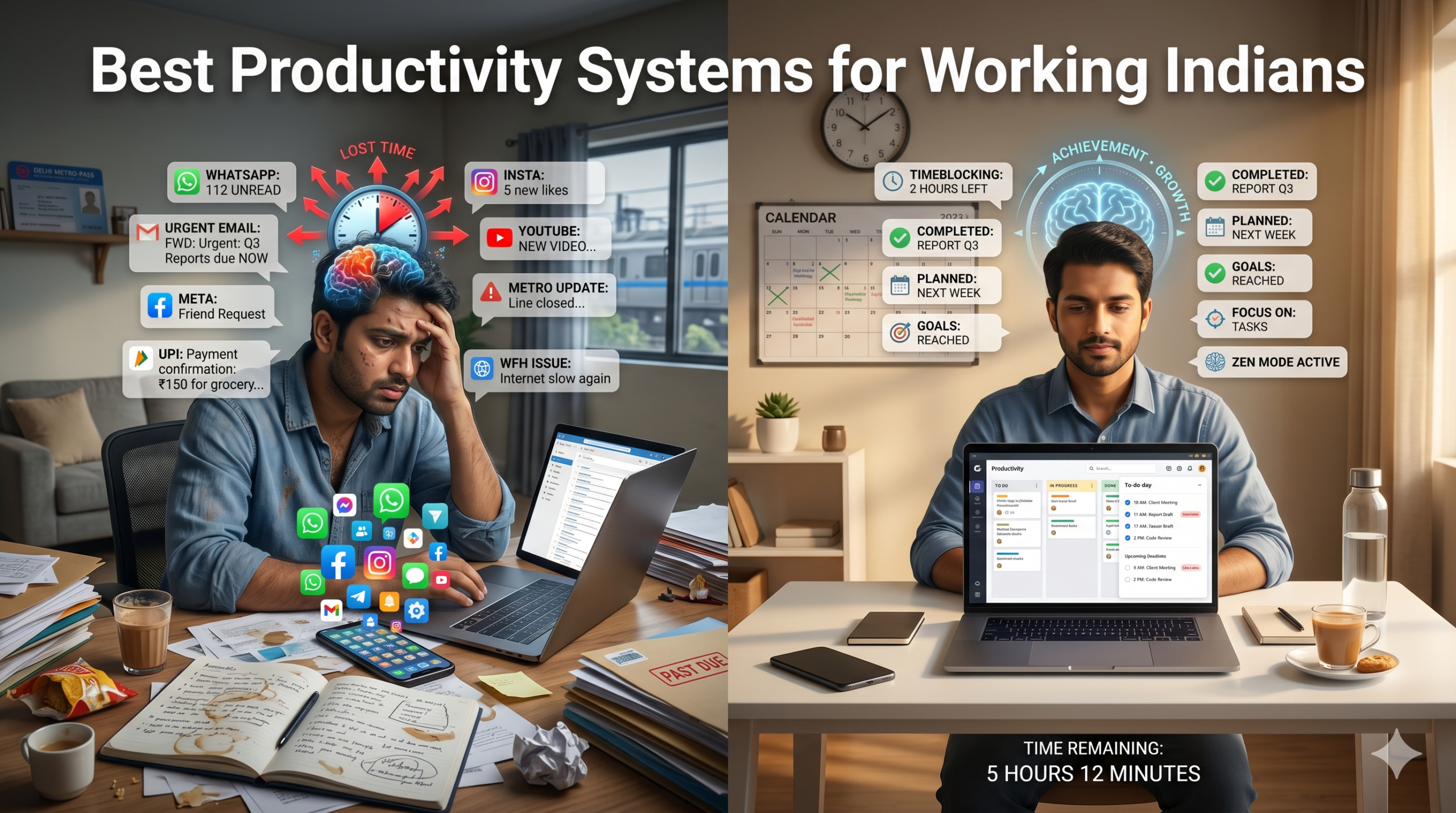
Most Indians are not lazy. They are overloaded.
Long commutes, WhatsApp distractions, office pressure, family responsibilities, and financial stress kill focus daily. Most productivity advice online is built for Silicon Valley workers, not for someone managing EMI payments, crowded trains, and 10-hour workdays.
The good news? You do not need complicated systems.
You need a productivity system that fits real Indian life.
This guide covers the best productivity systems for working Indians, how they work, who should use them, and how to apply them practically.
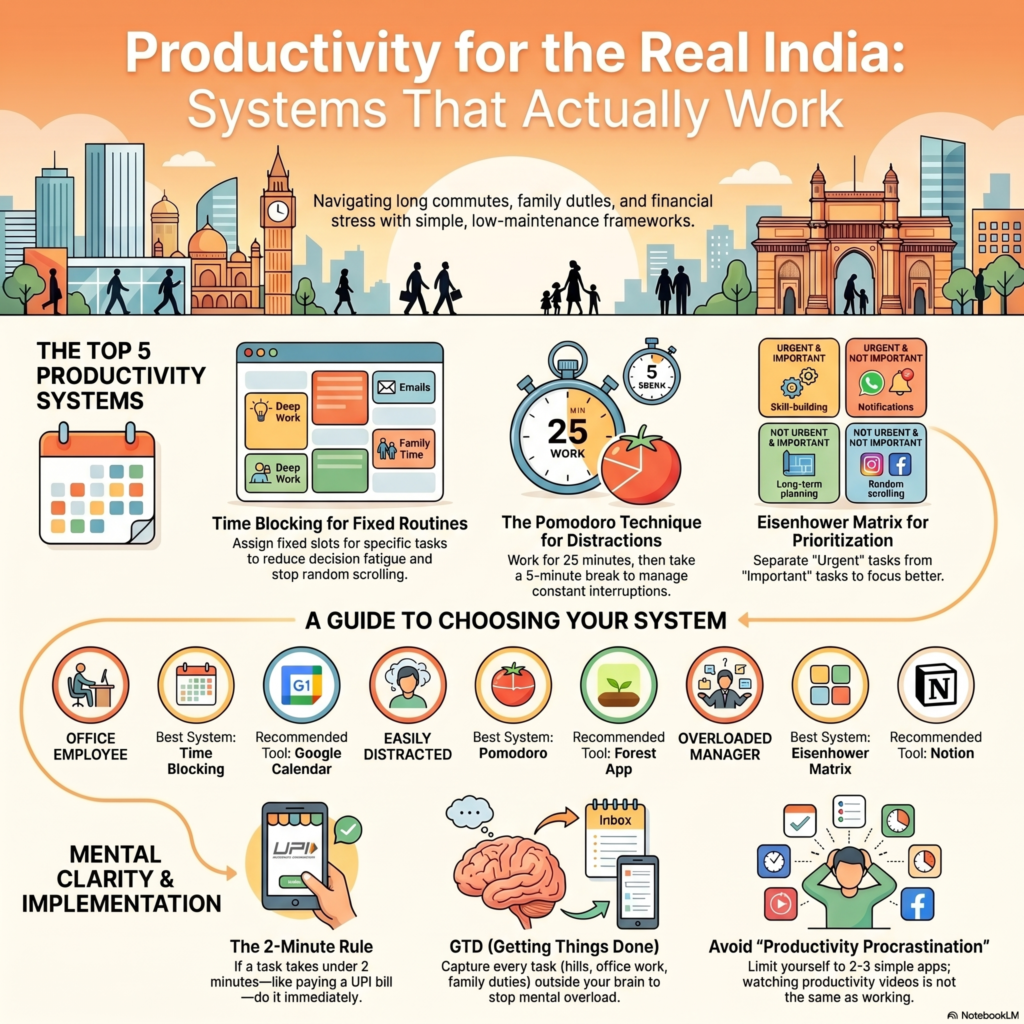
Quick Answer: Best Productivity Systems for Working Indians
Here are the most effective productivity systems for Indian professionals:
- Time Blocking: Best for office workers with fixed schedules
- Pomodoro Technique: Best for people distracted by mobile phones
- Eisenhower Matrix: Best for overloaded employees
- GTD (Getting Things Done): Best for multitaskers and freelancers
- 2-Minute Rule: Best for reducing mental clutter
The best system is the one you can follow consistently for 30 days.
Why Most Productivity Systems Fail in India
Most productivity advice ignores reality.
Indian workers deal with:
- Unpredictable office timings
- Family interruptions
- Power cuts and internet issues
- Constant notifications
- Side hustles after work
- Financial stress
A complicated system collapses fast.
Simple systems survive pressure.
That is why this article focuses on low-maintenance productivity systems.
1. Time Blocking Productivity System
What It Is
Time blocking means assigning fixed time slots for tasks.
Instead of saying:
“I will work on reports today.”
You say:
“7 PM to 8 PM: Finish monthly report.”
Why It Works
It reduces decision fatigue.
You stop wasting energy deciding what to do next.
Who Should Use It
Best for:
- IT employees
- Remote workers
- Students preparing for exams
- People with fixed routines
Example for Indian Workers
A Chennai IT employee earning ₹45,000 monthly:
| Time | Task |
| 6:00 AM – 7:00 AM | Exercise |
| 8:00 AM – 10:00 AM | Deep office work |
| 1:00 PM – 1:30 PM | Emails |
| 7:00 PM – 8:00 PM | Side hustle |
| 9:00 PM – 9:30 PM | Budget tracking |
This structure prevents random scrolling and wasted evenings.
Clear Action
Use free tools like:
- Google Calendar
- Notion
- TickTick
Start with just 3 blocked tasks daily.
Not 15.
2. Pomodoro Technique Productivity System
What It Is
Work for 25 minutes.
Take a 5-minute break.
Repeat 4 times.
Then take a longer break.
Why It Works
Indian workers get interrupted constantly.
Pomodoro creates short focus bursts.
Short sessions feel manageable.
Who Should Use It
Best for:
- Students
- Content creators
- People addicted to mobile notifications
- Employees working from home
Example
A freelancer editing videos:
- 25 minutes editing
- 5 minutes break
- Repeat
Instead of sitting “all day,” productivity becomes measurable.
Clear Action
Use:
- Forest
- Focus To-Do
Keep your phone in another room during sessions.
Otherwise this system becomes useless.
3. Eisenhower Matrix Productivity System
What It Is
This system separates tasks into 4 categories:
| Type | Meaning |
| Urgent + Important | Do immediately |
| Important + Not Urgent | Schedule |
| Urgent + Not Important | Delegate |
| Not Important | Eliminate |
Why It Works
Most people confuse urgency with importance.
WhatsApp messages feel urgent.
Building skills is important.
Huge difference.
Who Should Use It
Best for:
- Managers
- Business owners
- Employees with heavy workloads
Example
A sales employee earning ₹60,000 monthly:
Important
- Learning Excel automation
- Health insurance planning
- SIP investment review
Not Important
- Endless Instagram reels
- Random office gossip
- Checking email every 5 minutes
The system forces brutal prioritization.
Clear Action
Before work starts, write:
- Top 3 important tasks
- Top distractions to avoid
This alone improves focus massively.
4. GTD (Getting Things Done)
What It Is
Created by David Allen, GTD focuses on capturing every task outside your brain.
You stop mentally storing everything.
Why It Works
Indian professionals juggle too many responsibilities:
- Office work
- Family duties
- Bills
- Side income
- Loans
- Insurance renewals
Mental overload destroys productivity.
Who Should Use It
Best for:
- Freelancers
- Entrepreneurs
- Multi-project workers
Simple GTD Workflow
Step 1: Capture everything
Write every task immediately.
Step 2: Organize tasks
Sort by category.
Step 3: Prioritize
Pick only high-value work.
Step 4: Review weekly
Remove useless tasks.
Clear Action
Use:
- Todoist
- Microsoft To Do
Avoid maintaining complicated dashboards.
Most people waste time “organizing productivity.”
5. 2-Minute Rule
What It Is
If a task takes under 2 minutes, do it immediately.
Examples:
- Paying electricity bill
- Replying to an important email
- Booking a gas cylinder
- Sending UPI payment
Why It Works
Small pending tasks create mental stress.
They silently drain energy.
Who Should Use It
Everyone.
Especially people who procrastinate small tasks.
Clear Action
Spend 15 minutes daily clearing tiny pending tasks.
You will instantly feel lighter mentally.
Best Productivity System Based on Your Situation
| Situation | Best System |
| Office employee | Time Blocking |
| Easily distracted | Pomodoro |
| Overloaded manager | Eisenhower Matrix |
| Freelancer | GTD |
| Chronic procrastination | 2-Minute Rule |
Do not combine 7 systems together.
That becomes another distraction.
Real-Life Indian Example
Rahul works in Bengaluru.
Monthly salary: ₹52,000.
Monthly Expenses
| Expense | Amount |
| Rent | ₹14,000 |
| Food | ₹6,000 |
| Bike EMI | ₹4,500 |
| SIP Investment | ₹5,000 |
| Family support | ₹8,000 |
| Miscellaneous | ₹7,000 |
He wanted extra freelance income but wasted evenings on YouTube and Instagram.
He implemented:
- Time blocking
- Pomodoro
- 2-Minute Rule
Result after 3 months:
- Earned extra ₹12,000 freelancing
- Reduced screen time by 2 hours daily
- Completed insurance and SIP planning
- Improved sleep schedule
No motivational speeches.
Just better systems.
Common Productivity Mistakes Indians Make
1. Using Too Many Apps
You do not need 12 productivity apps.
One calendar and one task app is enough.
2. Watching Productivity Videos Instead of Working
Many people consume productivity content endlessly.
That is procrastination disguised as learning.
3. Ignoring Sleep
Sleep-deprived people are not productive.
They are simply slower.
4. Creating Unrealistic Schedules
A schedule starting at 4 AM usually fails within days.
Build around your actual lifestyle.
5. Not Tracking Money and Time Together
Time waste often creates money problems.
Late fees, missed investments, bad spending decisions — all linked.
Pro Tips That Actually Help
- Keep phone notifications off during work
- Track screen time weekly
- Schedule important work before lunch
- Use UPI autopay for bills
- Plan tomorrow before sleeping
- Keep Sundays for weekly review
Small systems beat intense motivation.
Every time.
Useful Tools and Apps for Productivity
These tools work well for Indian users:
| Tool | Use Case |
| Google Calendar | Scheduling |
| Notion | Planning |
| Forest | Focus sessions |
| Todoist | Task tracking |
| CRED | Bill reminders |
| Groww | SIP tracking |
Good productivity improves finances indirectly.
People who manage time well usually manage money better too.
FAQ: Best Productivity Systems for Working Indians
Which productivity system is best for beginners?
Time blocking is best for beginners because it is simple and practical.
How can Indian employees avoid distractions?
Turn off notifications, use Pomodoro sessions, and keep fixed work hours.
Is Notion good for productivity?
Yes, but many people overcomplicate it. Use simple pages only.
How many productivity apps should I use?
Maximum two or three.
Too many apps reduce actual work.
Can productivity systems improve finances?
Yes. Better time management reduces missed payments, improves side income, and supports investing habits.
What is the biggest productivity mistake?
Trying to completely change your life overnight.
That usually fails fast.
Conclusion
The best productivity systems for working Indians are simple, repeatable, and realistic.
You do not need a perfect morning routine.
You need fewer distractions and better structure.
Start with one system:
- Time Blocking
- Pomodoro
- GTD
- Eisenhower Matrix
- 2-Minute Rule
Test it for 30 days.
Keep what works.
Delete what does not.
That is real productivity.