

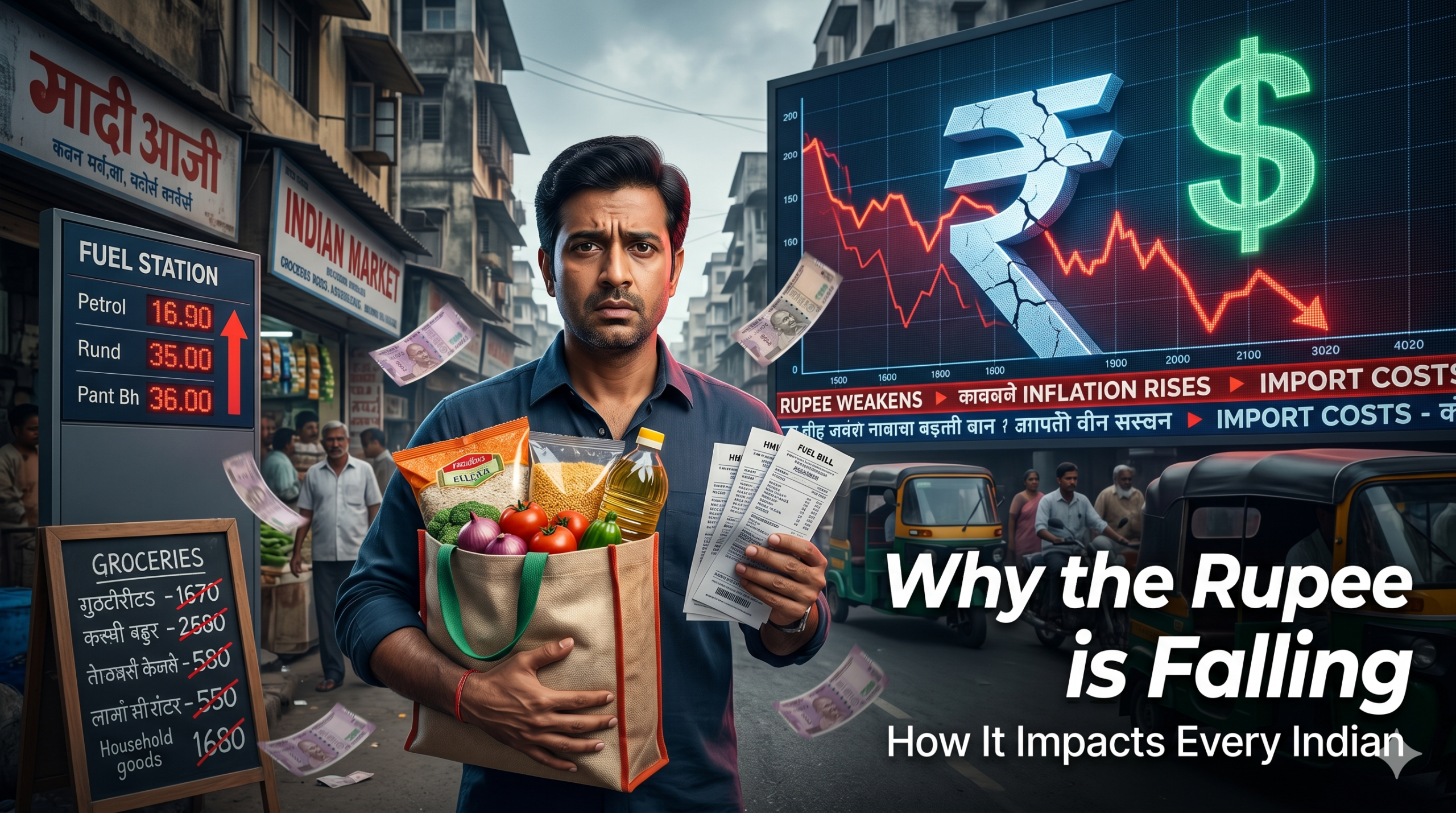
The Indian rupee keeps falling against the US dollar. And most people only notice it when petrol prices rise, groceries get expensive, or foreign products cost more.
But the real impact goes deeper.
A weak rupee affects your savings, investments, travel plans, loans, and monthly budget. Even if you never deal with dollars directly, you still pay the price indirectly.
In this guide, you’ll understand why the rupee is falling, how it affects ordinary Indians, and what practical steps you can take to protect your money.
Quick Answer: Why the Rupee is Falling
Here’s the short version:
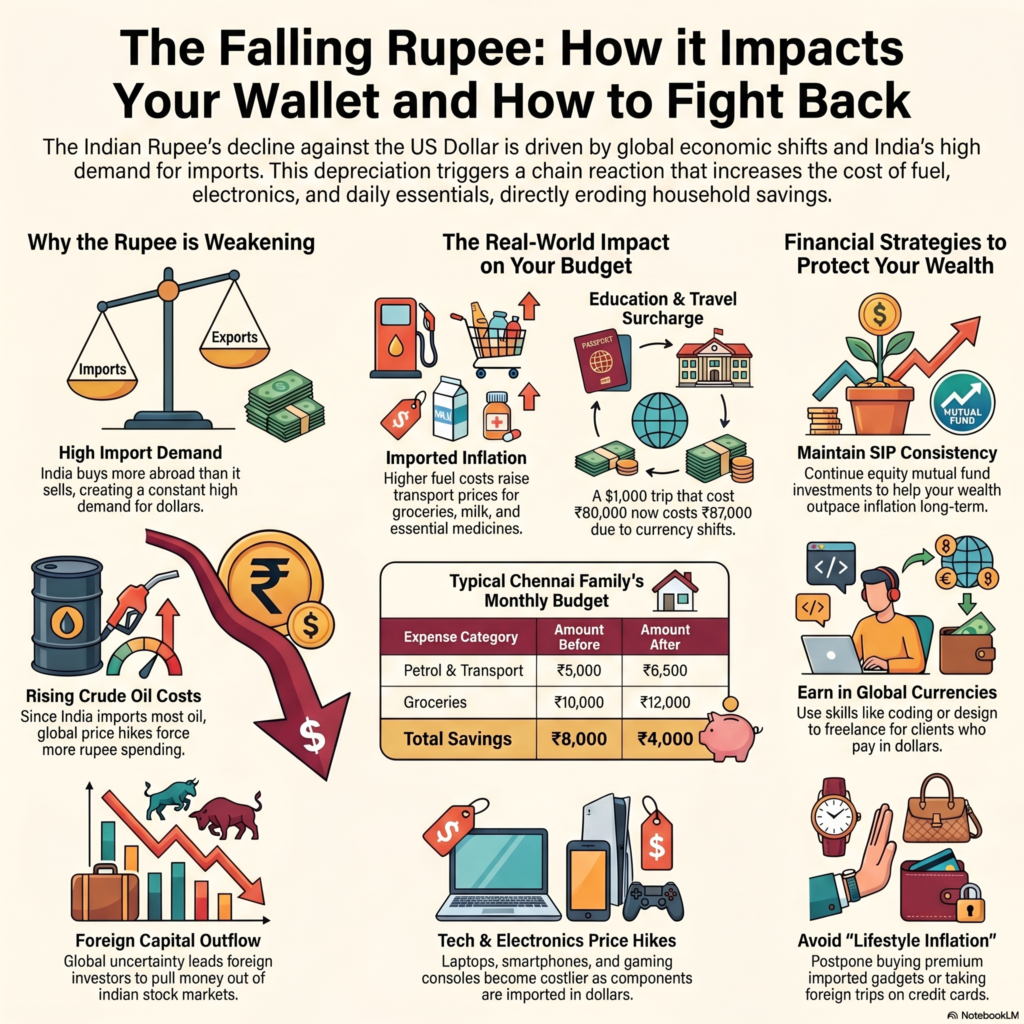
- India imports more than it exports
- Crude oil prices increase dollar demand
- Foreign investors pull money from Indian markets
- Strong US economy strengthens the dollar
- Inflation and interest rate differences weaken the rupee
For Indian citizens, this means:
- Petrol and imported goods become costly
- Foreign travel and education get expensive
- Inflation rises
- Gold prices usually increase
- IT exporters may benefit
What Does “Rupee Falling” Actually Mean?
When people say the rupee is falling, they mean:
The Indian rupee buys fewer US dollars than before.
Example:
- Earlier: ₹80 = $1
- Now: ₹87 = $1
This means India needs more rupees to buy the same dollar.
That increases the cost of imports.
And India imports a lot.
Especially:
- Crude oil
- Electronics
- Mobile phones
- Semiconductors
- Medical equipment
- Gold
Why the Rupee is Falling in India
1. India Imports More Than It Exports
India buys more goods from other countries than it sells.
This creates high demand for dollars.
Oil companies need dollars.
Electronics importers need dollars.
Foreign payments happen mostly in dollars.
Higher dollar demand weakens the rupee.
Real Impact
Your:
- Petrol bill rises
- LPG cylinder price increases
- Grocery transport costs rise
Even vegetables become expensive because transport depends on fuel.
2. Rising Crude Oil Prices
India imports most of its crude oil.
When oil prices rise globally:
- India spends more dollars
- Dollar demand increases
- Rupee weakens further
This creates a chain reaction.
Fuel becomes expensive.
Transport becomes expensive.
Everything becomes expensive.
3. Foreign Investors Pulling Money Out
Foreign investors invest heavily in Indian stock markets.
When global uncertainty rises, they move money to safer markets like the US.
To exit India:
- They sell Indian assets
- Convert rupees into dollars
- Take dollars out
That weakens the rupee.
This Usually Happens During:
- Wars
- Global recessions
- US interest rate hikes
- Market panic
4. Strong US Dollar
The US dollar becomes stronger when:
- US interest rates rise
- US economy performs better
- Global investors trust US markets more
A strong dollar automatically weakens many currencies, including the rupee.
This is not only India’s problem.
Many developing countries face the same issue.
5. Inflation in India
If inflation rises faster in India than in the US:
- Purchasing power drops
- Currency value weakens over time
Higher inflation slowly damages currency strength.
Impact of Falling Rupee on Indian Citizens
Petrol and Diesel Become Costly
India imports crude oil in dollars.
Weak rupee = expensive imports.
That raises:
- Petrol prices
- Diesel prices
- Transport charges
And transport affects almost every product.
Mobile Phones and Electronics Cost More
Many electronics are imported or assembled using imported parts.
Products affected:
- iPhones
- Laptops
- TVs
- Gaming consoles
- Cameras
Even budget smartphones become costlier.
Foreign Travel Becomes Expensive
A weak rupee destroys travel budgets quickly.
You spend more on:
- Hotel bookings
- Flights
- Visa fees
- Food abroad
- Shopping
Example
Earlier:
- $1,000 trip = ₹80,000
Now:
- $1,000 trip = ₹87,000
Same trip.
₹7,000 extra cost.
Studying Abroad Gets Harder
Students paying fees in dollars, pounds, or euros suffer heavily.
Tuition fees rise instantly when the rupee weakens.
Families often need bigger education loans.
Inflation Hits Daily Life
This is the biggest problem.
Imported inflation slowly enters every sector.
You notice it in:
- Groceries
- Milk
- Cooking oil
- Medicines
- Transport
- Online shopping
Salary stays same.
Expenses increase.
That reduces real savings.
Gold Prices Usually Rise
Indians buy gold heavily.
Gold is priced globally in dollars.
When the rupee falls:
- Gold becomes costlier in India
- Jewelry prices rise
This is why gold often rises during currency weakness.
Who Benefits When the Rupee Falls?
Not everyone loses.
Some sectors benefit.
IT Companies
Indian IT companies earn in dollars.
When they convert dollars into rupees, profits increase.
Companies like:
- Infosys
- Tata Consultancy Services
- Wipro
can benefit from a weaker rupee.
Export Businesses
Exporters earn foreign currency.
Examples:
- Textile exporters
- Pharma exporters
- Software companies
They receive more rupees for every dollar earned.
Real-Life Example: How a Weak Rupee Affects a Middle-Class Family
Let’s take a Chennai family earning ₹65,000 monthly.
Before Rupee Fall
| Expense | Amount |
| Rent | ₹15,000 |
| Petrol | ₹5,000 |
| Groceries | ₹10,000 |
| EMI | ₹12,000 |
| School Fees | ₹6,000 |
| Savings | ₹8,000 |
After Rupee Weakens
| Expense | Amount |
| Rent | ₹15,000 |
| Petrol | ₹6,500 |
| Groceries | ₹12,000 |
| EMI | ₹12,000 |
| School Fees | ₹6,500 |
| Savings | ₹4,000 |
Savings reduced by 50%.
That’s the real problem.
Not headlines.
Not exchange rates.
Your monthly breathing space disappears.
Common Mistakes People Make During Rupee Fall
1. Panic Buying Gold
Gold helps long term.
But buying jewelry emotionally is stupid financially.
Jewelry has:
- Making charges
- Wastage
- GST
Digital gold or Gold ETFs are usually smarter.
2. Keeping All Savings in Cash
Inflation quietly destroys idle cash.
₹1 lakh today won’t have the same value later.
3. Ignoring Investments
Many stop SIPs during uncertainty.
That usually backfires.
Market corrections often create better buying opportunities.
4. Taking Foreign Trips on Credit
Weak rupee + credit card debt = financial damage.
Especially with high forex markup charges.
5. Depending Only on Salary
Inflation rises faster than many salary hikes.
One income source becomes risky over time.
What Indian Citizens Should Do Now
Continue SIP Investments
Equity mutual funds can help beat inflation long term.
Useful platforms:
- Groww
- Zerodha
- ET Money
Focus on:
- Index funds
- Flexi-cap funds
- Large-cap funds
Build Emergency Savings
Keep at least:
- 3–6 months expenses
in a high-interest savings account or liquid fund.
Reduce Imported Lifestyle Spending
This includes:
- Premium gadgets
- Frequent international travel
- Luxury foreign products
Weak rupee makes these financially inefficient.
Increase Skills That Earn in Dollars
Freelancing and remote work can become powerful.
Fields with global demand:
- Coding
- Design
- Video editing
- Content writing
- AI tools
Earning dollars while spending rupees creates a huge advantage.
Avoid Unnecessary Loans
Especially:
- Personal loans
- Credit card EMI traps
- BNPL apps
High inflation periods punish debt-heavy lifestyles.
Pro Tips to Protect Your Money During Rupee Fall
- Continue SIPs even during market fear
- Track inflation, not just salary growth
- Keep some investments in gold ETFs
- Learn a dollar-earning skill
- Avoid lifestyle inflation after salary hikes
Best Financial Tools to Handle Inflation and Currency Weakness
Investment Apps
- Groww
- Upstox
- Zerodha
Useful for:
- SIPs
- ETFs
- Index investing
Budget Tracking Apps
- Walnut
- Money Manager
These help track rising expenses properly.
High-Interest Savings Accounts
Compare banks offering:
- Better FD rates
- Low-fee accounts
- Strong digital banking
This matters more during inflation periods.
FAQ: Why the Rupee is Falling
Is a falling rupee good or bad?
Mostly bad for consumers.
It increases inflation and import costs.
But exporters and IT companies may benefit.
Will petrol prices increase if the rupee falls?
Usually yes.
India imports crude oil in dollars.
Weak rupee raises fuel import costs.
Does falling rupee affect stock markets?
Yes.
Foreign investors may pull money out.
Imported companies face higher costs.
But export companies may gain.
Should I stop SIPs during rupee fall?
No.
Stopping SIPs during uncertainty is usually a mistake.
Long-term investing works better with consistency.
Why is the US dollar becoming stronger?
Higher US interest rates and global investor confidence strengthen the dollar.
Can the rupee recover?
Yes.
Currency values move based on:
- Economy
- Inflation
- Trade balance
- Global conditions
But recovery takes time.
Conclusion
The falling rupee affects almost every Indian household.
You may not see dollars daily.
But you feel the impact everywhere:
- Fuel
- Groceries
- Electronics
- Education
- Travel
The mistake is thinking this only matters to rich people or investors.
It affects middle-class savings the most.
You cannot control currency markets.
But you can control:
- Spending habits
- Investments
- Debt
- Income skills
That matters more than predicting the dollar rate.