


Most Indians start investing with one simple question.
“Should I pick index funds or active mutual funds?”
Then confusion starts.
One YouTube creator says active funds beat the market. Another says index funds are safer. Meanwhile, your bank relationship manager pushes expensive mutual funds with high commissions.
Here’s the reality.
Most beginners do not need complicated investing strategies. They need low-cost, practical investments that grow steadily over time.
In this guide, you’ll learn:
- The real difference between index funds and active funds in India
- Which option works better for beginners
- Where active funds still make sense
- What most investors get wrong
- How to choose based on your income and goals
Quick Answer: Index Funds vs Active Funds in India
If you want the short answer, here it is.
- Choose index funds if you want low fees and simple investing
- Choose active funds if you can tolerate higher risk
- Most beginners are better off with index funds
- Active funds can outperform, but many fail consistently
- Long-term investing matters more than chasing “best” funds
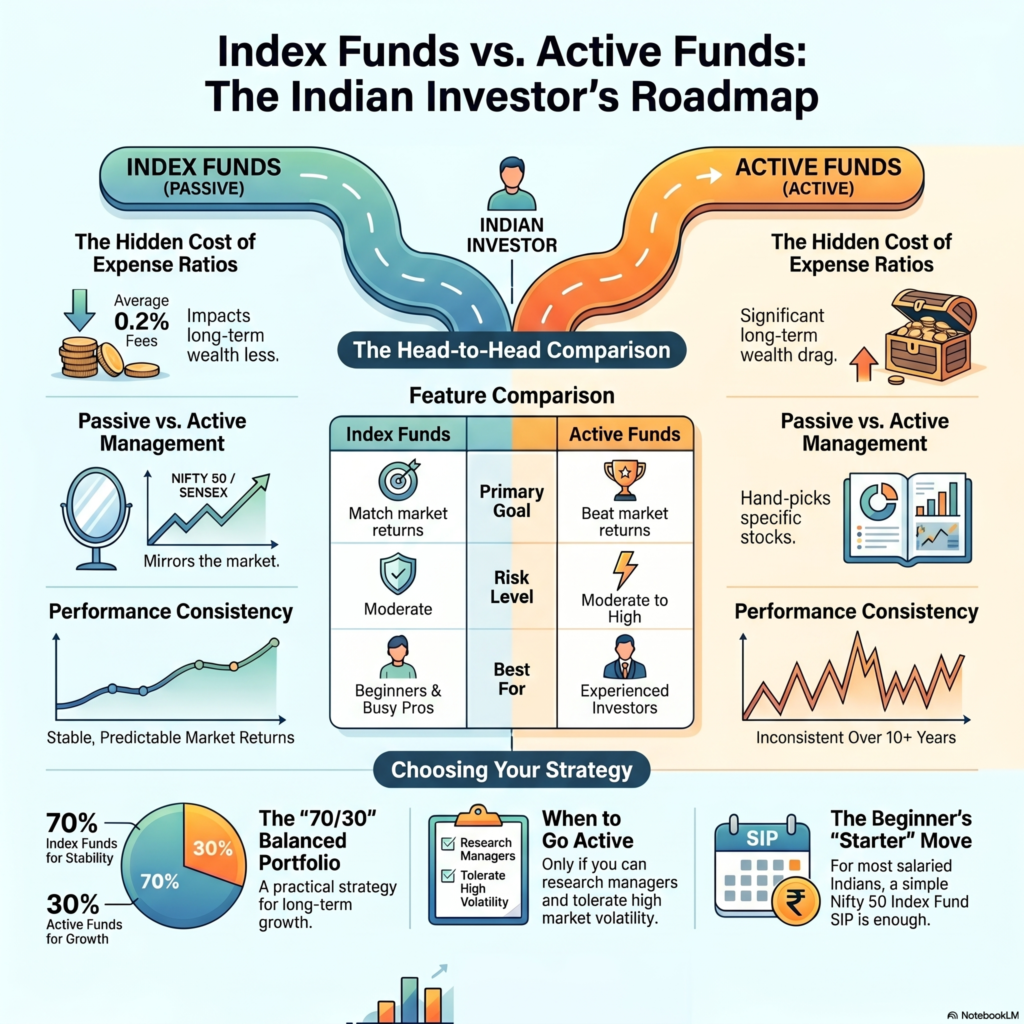
For most salaried Indians, a Nifty 50 index fund SIP is enough to start.
What Are Index Funds?
Index funds simply copy a stock market index.
Example:
- Nifty 50 Index Fund = invests in the top 50 Indian companies
- Sensex Index Fund = follows the 30 Sensex companies
No fund manager actively picks stocks.
The fund just mirrors the market.
That means:
- Lower fees
- Less human error
- Predictable performance
Popular index funds in India include:
- UTI Nifty 50 Index Fund
- HDFC Index Nifty 50 Fund
- ICICI Prudential Nifty Next 50 Index Fund
What Are Active Funds?
Active funds are managed by professional fund managers.
Their job:
- Pick stocks
- Beat the market
- Generate higher returns
Sounds good in theory.
Problem is, many active funds fail to beat the index after fees and taxes.
Still, some active funds perform very well during certain market cycles.
Examples:
- Flexi-cap funds
- Mid-cap funds
- Small-cap funds
Popular active fund categories include:
- Flexi Cap Funds
- ELSS Funds
- Mid Cap Funds
- Small Cap Funds
Index Funds vs Active Funds in India: Key Differences
| Feature | Index Funds | Active Funds |
| Management | Passive | Active |
| Expense Ratio | Very low | Higher |
| Goal | Match market returns | Beat market returns |
| Risk Level | Moderate | Moderate to High |
| Transparency | High | Medium |
| Fund Manager Dependence | No | Yes |
| Best For | Beginners | Experienced investors |
| Returns Consistency | Stable | Unpredictable |
| Taxation | Same | Same |
Why Index Funds Became Popular in India
Three reasons.
1. Lower Costs
Expense ratio matters more than people think.
Example:
- Index fund expense ratio: 0.2%
- Active fund expense ratio: 1.8%
That difference compounds for decades.
On a ₹10 lakh portfolio, you could lose lakhs in extra fees.
2. Most Active Funds Underperform Eventually
Many active funds beat the market for 1–3 years.
Very few sustain it for 10–15 years.
Most investors look only at recent returns. That’s a mistake.
Past performance is not reliable.
3. Simple Investing Wins Long-Term
Most people overcomplicate investing.
They buy:
- 8 mutual funds
- random stocks
- crypto
- penny stocks
Then panic during crashes.
A simple SIP in an index fund usually beats emotional investing.
When Active Funds Make More Sense
Active funds are not useless.
That “index funds are always better” narrative is lazy thinking.
Active funds can work well in certain situations.
Choose Active Funds If:
You Want Higher Growth Potential
Good active mid-cap and small-cap funds can outperform indexes.
But risk is higher.
You Understand Market Cycles
Active investing requires patience.
Many investors quit after one bad year.
That destroys returns.
You Can Research Fund Managers
The fund manager matters heavily in active funds.
A bad manager can ruin performance.
Most beginners do not track this properly.
Index Funds vs Active Funds in India: Pros and Cons
Index Funds Pros
- Low cost
- Easy to understand
- Lower risk of underperformance
- Great for SIP investing
- Less stress
Index Funds Cons
- Cannot outperform market
- Limited flexibility
- Falls whenever market falls
Active Funds Pros
- Chance of higher returns
- Better flexibility
- Can outperform during certain periods
Active Funds Cons
- High fees
- Performance inconsistency
- Depends on fund manager quality
- Harder to select correctly
Real-Life Example: Salaried Employee in India
Let’s take Rahul.
- Age: 28
- Salary: ₹55,000/month
- Rent: ₹12,000
- Groceries: ₹6,000
- Bike EMI: ₹4,000
- Savings available: ₹10,000/month
Rahul wants long-term wealth creation.
Option 1: Index Fund SIP
He invests:
- ₹10,000/month
- Nifty 50 Index Fund
- Average return assumption: 12%
After 20 years:
- Total invested: ₹24 lakh
- Approx value: ₹99 lakh+
Option 2: Active Fund SIP
He invests:
- ₹10,000/month
- Flexi-cap active fund
- Return assumption: 14%
After 20 years:
- Approx value: ₹1.18 crore
Looks better.
But here’s the catch.
Most investors:
- switch funds frequently
- stop SIPs during crashes
- choose poor-performing active funds
That reduces actual returns heavily.
For disciplined beginners, index funds are usually safer.
Who Should Choose Index Funds?
Choose index funds if:
- You are new to investing
- You want passive wealth building
- You don’t track markets regularly
- You prefer lower risk
- You want low-cost investing
This suits:
- Salaried employees
- Beginners
- Busy professionals
- First-time SIP investors
Who Should Choose Active Funds?
Choose active funds if:
- You understand mutual fund analysis
- You can stay invested during volatility
- You want aggressive growth
- You can review funds yearly
- You accept higher risk
This suits:
- Experienced investors
- Long-term aggressive investors
- Investors targeting alpha returns
Best Strategy for Most Indians
Here’s what actually works for many people.
Use both.
Example portfolio:
- 70% Index Funds
- 30% Active Funds
This gives:
- Stability from index funds
- Growth potential from active funds
Simple. Balanced. Practical.
Not flashy.
But effective.
Common Mistakes People Make
1. Chasing Last Year’s Top Fund
A fund performing well today may crash tomorrow.
Stop blindly following rankings.
2. Investing in Too Many Funds
Owning 10 mutual funds is pointless.
Most portfolios overlap heavily.
3. Ignoring Expense Ratios
High fees quietly destroy long-term wealth.
Many people never check this.
4. Stopping SIPs During Market Crashes
This is where real wealth gets built.
Panic selling ruins compounding.
5. Expecting Quick Returns
Mutual funds are not lottery tickets.
Wealth creation takes years.
Pro Tips for Better Mutual Fund Investing
Start With One Fund
Do not build a complicated portfolio initially.
One good index fund is enough.
Increase SIP Every Year
Even a 10% SIP increase matters massively.
Salary grows. SIP should too.
Review Once a Year Only
Daily checking creates emotional decisions.
Long-term investing needs patience.
Keep Emergency Savings Separate
Do not invest money needed within 1–2 years.
Use savings accounts or liquid funds instead.
Use Direct Plans
Direct mutual funds save expense costs.
Long-term difference becomes huge.
Best Platforms to Invest in Index Funds and Active Funds
Popular investment platforms in India:
- Groww
- Zerodha
- Upstox
- ET Money
- Paytm Money
Useful features to look for:
- Direct mutual fund investing
- SIP automation
- Goal tracking
- Low platform fees
Avoid buying regular mutual funds through aggressive bank sales pitches.
Those often carry higher commissions.
FAQ: Index Funds vs Active Funds in India
Are index funds safer than active funds?
Generally yes.
They spread risk across large companies and avoid fund manager mistakes.
Can active funds beat index funds?
Yes, some do.
But very few consistently outperform over long periods.
Which is better for beginners in India?
Index funds are usually better for beginners.
They are simpler and cheaper.
Is SIP better in index funds?
For most salaried investors, yes.
Index fund SIPs are easy to maintain long-term.
Should I invest in both index and active funds?
Yes, that can work well.
Many investors use a combination strategy.
Which index fund is best in India?
Popular choices include:
- Nifty 50 Index Funds
- Sensex Index Funds
- Nifty Next 50 Funds
Choose low expense ratios and trusted AMCs.
Final Verdict
Most Indian investors do not fail because they chose the wrong fund.
They fail because:
- they panic
- chase trends
- stop investing early
- overcomplicate everything
Index funds are boring.
That’s exactly why they work.
Active funds can outperform. But they require better selection and stronger discipline.
If you are starting today:
- Begin with a simple index fund SIP
- Stay consistent
- Increase investments yearly
- Ignore market noise
That alone puts you ahead of most people already.