


Earning ₹30,000 feels tight. Rent, food, travel… money disappears fast.
End of the month? Zero balance again.
This isn’t because you earn less. It’s because there’s no system.
In this guide, you’ll learn exactly how to save money on ₹30,000 salary in India—step by step, using real numbers and practical actions.
Quick Answer
To save money on a ₹30,000 salary in India:
- Follow a 50-30-20 rule (modified) based on reality
- Fix your rent and food costs first
- Automate saving ₹3,000–₹6,000 monthly
- Cut 3 silent expenses (subscriptions, eating out, impulse buys)
- Increase income with one side skill or freelance work
Saving is not about “cutting everything.”
It’s about controlling the big expenses first.
Most people fail because:
- They track small expenses
- Ignore rent, lifestyle, and habits
Your focus should be:
Fixed costs → habits → automation
Step-by-Step Plan to Save Money on ₹30,000 Salary
Step 1: Fix Your Budget (Realistic Version)
Forget textbook budgets.
Use this instead:
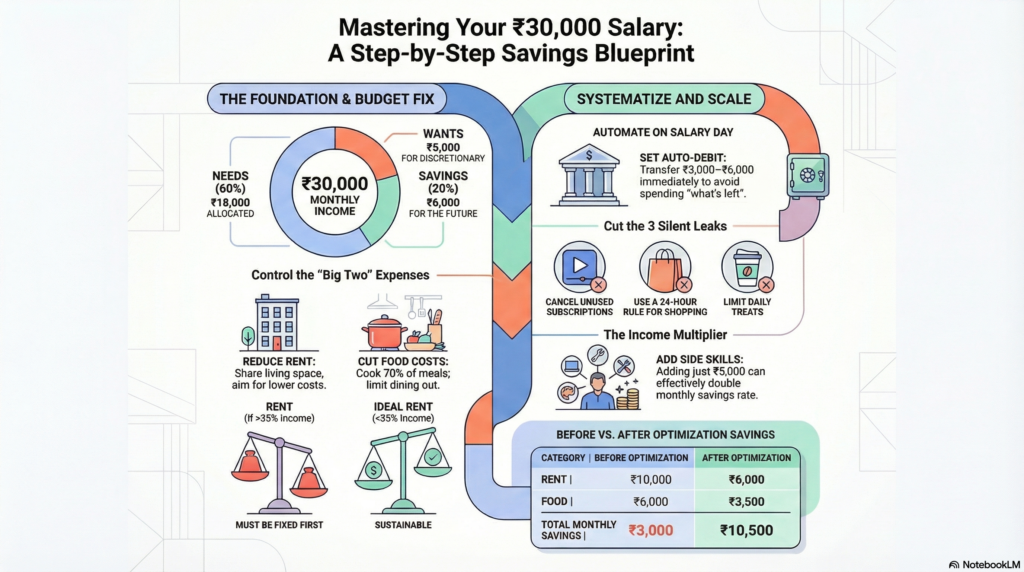
- Needs (60%) → ₹18,000
- Wants (20%) → ₹6,000
- Savings (20%) → ₹6,000
Example:
- Rent: ₹8,000
- Food: ₹5,000
- Transport: ₹3,000
- Bills: ₹2,000
Total = ₹18,000
Action:
Write your exact numbers today. Not tomorrow.
Step 2: Control Rent (Biggest Expense)
Rent eats your salary.
What to do:
- Share room/flat
- Move slightly outside prime area
- Avoid “status rent”
Example:
- Single room: ₹10,000
- Shared: ₹6,000
You save ₹4,000 instantly
Action:
If rent > 35% of income, fix this first.
Step 3: Fix Food Spending (Hidden Leak)
Swiggy and Zomato will kill your savings.
What to do:
- Cook 70% of meals
- Limit eating out to weekends
- Buy groceries weekly
Example:
- Ordering daily: ₹6,000/month
- Cooking: ₹3,500/month
You save ₹2,500
Action:
Track food spending for 7 days. You’ll see the problem.
Step 4: Automate Savings First
If you save “what’s left,” you’ll save nothing.
What to do:
- Set auto-transfer on salary day
- Move ₹3,000–₹6,000 immediately
Where to put:
- Savings account (short term)
- SIP (long term)
Action:
Set auto-debit today. No excuses.
Step 5: Cut These 3 Expenses Immediately
These look small. They aren’t.
1. Subscriptions
- OTT, apps, random tools
Cut or share accounts
2. Impulse Shopping
- Amazon “offers” trap
24-hour rule before buying
3. Daily Treat Spending
- Tea, snacks, random spends
Limit to fixed budget
Action:
Cancel at least 2 subscriptions today.
Step 6: Increase Income (Non-Negotiable)
Saving alone won’t work long-term.
Options:
- Freelancing (writing, design, editing)
- Instagram + small business
- Weekend gigs
Example:
Extra ₹5,000/month = double your savings
Action:
Pick one skill. Start within 7 days.
Real-Life Example (₹30,000 Salary Breakdown)
Rahul, 26, Chennai
Income: ₹30,000
| Category | Before | After |
| Rent | ₹10,000 | ₹6,000 |
| Food | ₹6,000 | ₹3,500 |
| Transport | ₹3,000 | ₹3,000 |
| Bills | ₹2,000 | ₹2,000 |
| Wants | ₹6,000 | ₹5,000 |
| Savings | ₹3,000 | ₹10,500 |
He increased savings from ₹3K → ₹10.5K
No magic. Just control.
Common Mistakes
- Saving after spending everything
- Living alone for “privacy”
- Ordering food daily
- Ignoring small subscriptions
- Not increasing income
Fix these, and you’re already ahead of 80% people.
Pro Tips
- Use UPI + separate account for expenses
- Withdraw weekly cash for control
- Review spending every Sunday
- Avoid EMIs unless necessary
- Increase savings every salary hike
To make this system easier:
- Use SIP apps like Groww or Zerodha Coin
- Open a high-interest savings account
- Try expense trackers like Walnut or Money Manager
These tools automate discipline. You don’t rely on willpower.
FAQ
1. Can I really save on ₹30,000 salary?
Yes. You can save ₹3,000–₹10,000 with proper control.
2. What is the ideal saving percentage?
Start with 10%. Aim for 20% or more.
3. Should I invest or just save?
Do both. Save for emergencies. Invest for growth.
4. How much emergency fund is needed?
At least 3–6 months of expenses.
5. Is SIP good for beginners?
Yes. It’s simple and builds discipline.
Conclusion
Saving money on ₹30,000 salary is not hard.
But it requires discipline.
Control rent. Fix food. Automate savings. Increase income.
Do these four things consistently, and your finances will change.
No hacks. No shortcuts. Just execution.