

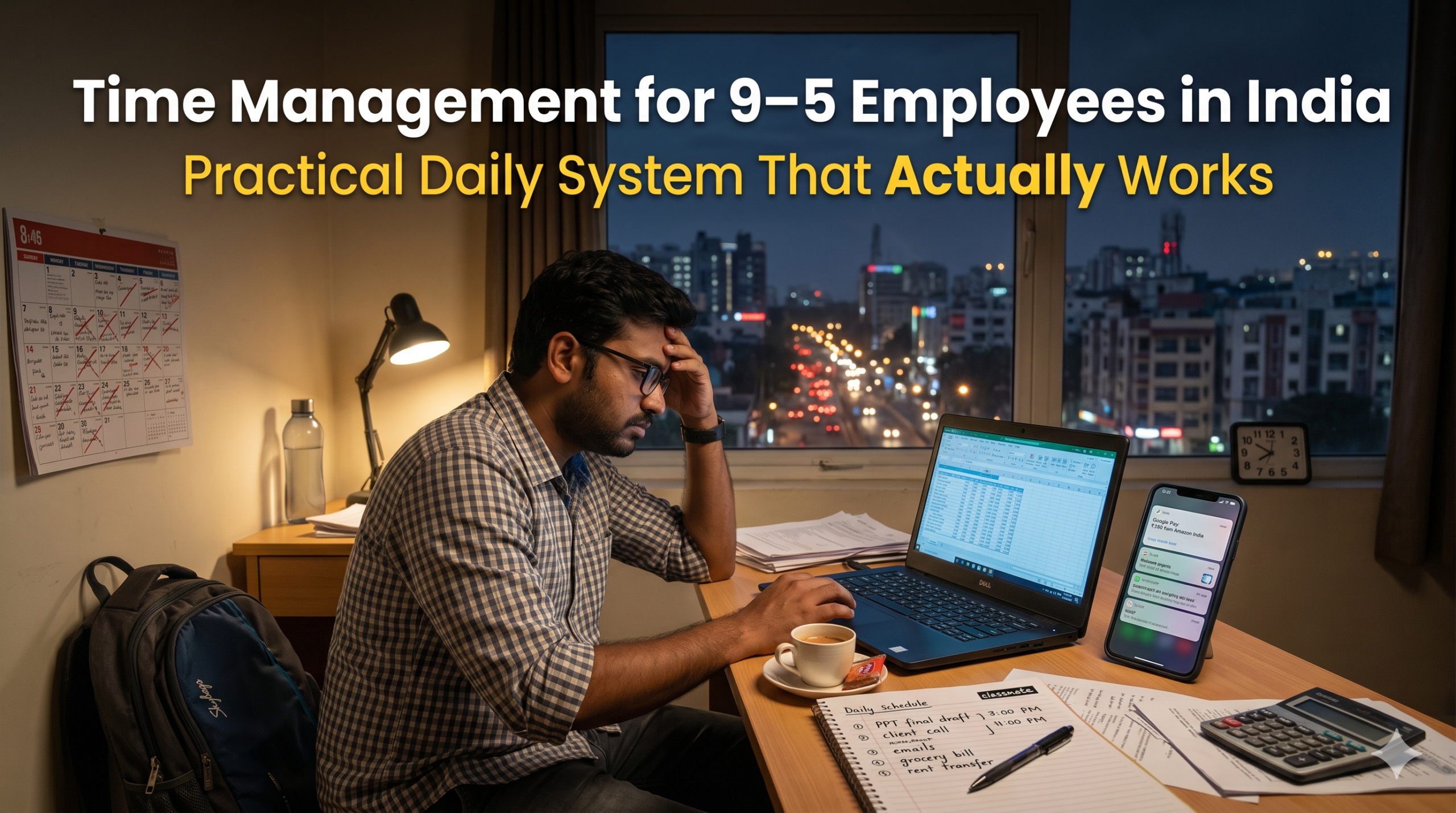
Most Indian employees are not bad at time management.
They are overloaded.
Long commutes, WhatsApp distractions, office politics, family responsibilities, and constant notifications destroy focus daily.
The result?
You feel busy the entire day but still finish important work late. Then personal goals suffer. Health suffers. Money planning gets delayed.
This guide explains practical time management for 9–5 employees in India using real-life routines, simple systems, and realistic examples.
Quick Answer: Best Time Management Tips for 9–5 Employees in India
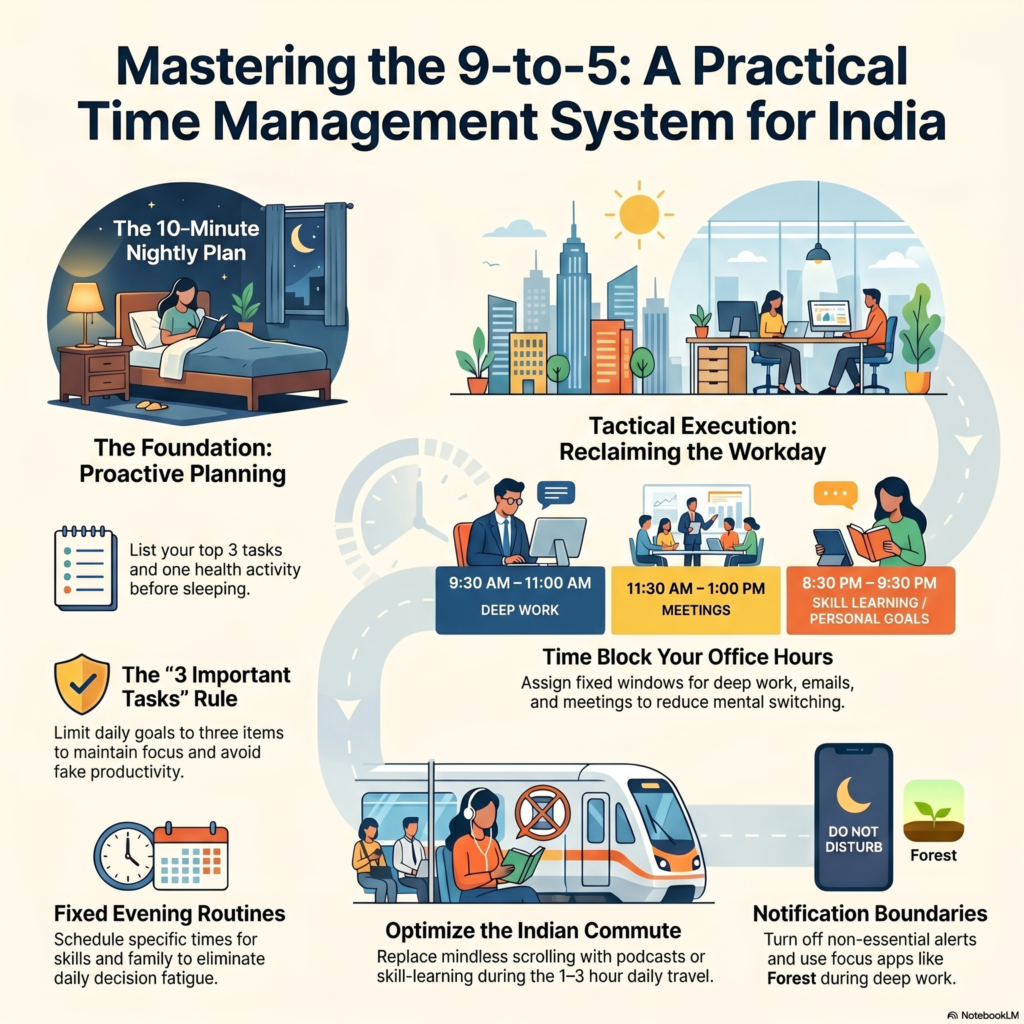
- Plan tomorrow before sleeping
- Focus on 3 important tasks daily
- Stop checking WhatsApp every 10 minutes
- Use commute time for learning or planning
- Track time leaks for one week
- Batch similar tasks together
- Sleep properly instead of “hustling” late
Why Time Management Matters More in India
Indian work culture often rewards availability, not productivity.
Many employees:
- Work beyond office hours
- Attend useless meetings
- Travel 1–3 hours daily
- Handle family responsibilities after work
Without a system, your entire week disappears in survival mode.
Good time management helps you:
- Reduce stress
- Learn high-income skills
- Build side income
- Improve health
- Handle money better
- Get promotion-ready
That matters more than downloading another productivity app.
Time Management for 9–5 Employees in India: Step-by-Step System
1. Stop Starting the Day Without a Plan
Most employees wake up and react immediately.
Phone. Emails. Messages. Calls.
That kills focus early.
What to do
Spend 10 minutes every night planning tomorrow.
Write:
- Top 3 important tasks
- Meetings
- Calls
- Personal tasks
- One health activity
Example
Instead of saying:
“I’ll study stock market later.”
Write:
- 8:30 PM to 9 PM — Learn mutual funds
Specific plans work better.
2. Use the “3 Important Tasks” Rule
Your daily task list should not have 25 items.
That is fake productivity.
Pick only 3 important tasks.
Why this works
Your brain focuses better with limited targets.
You finish meaningful work faster.
Good examples
- Finish insurance report
- Update SIP investment tracker
- Prepare client presentation
Bad examples
- Check emails
- Reply to WhatsApp
- Attend meetings
Those are maintenance activities.
Time Management for 9–5 Employees in India During Office Hours
3. Use Time Blocks
Time blocking means assigning fixed time for specific work.
Example Office Schedule
| Time | Task |
| 9:30 AM – 11 AM | Deep work |
| 11 AM – 11:30 AM | Emails |
| 11:30 AM – 1 PM | Meetings |
| 2 PM – 3:30 PM | Important tasks |
| 4 PM – 4:30 PM | Calls |
| 5 PM – 5:30 PM | Planning tomorrow |
Why it works
Your brain stops switching constantly.
That saves mental energy.
4. Control WhatsApp and Instagram
Most employees underestimate distraction damage.
Checking the phone for “2 minutes” becomes 25 minutes.
Action plan
- Turn off non-essential notifications
- Keep phone away during deep work
- Use app timers
- Check messages only at fixed times
Best apps
Don’t install 15 productivity apps.
You will waste time managing tools instead of work.
5. Use Your Commute Properly
In Indian cities, commute time is huge.
Chennai, Bengaluru, Mumbai, Hyderabad — traffic consumes hours.
You cannot always avoid it.
But you can use it better.
During commute you can:
- Listen to finance podcasts
- Learn English communication
- Watch investing videos
- Plan your day
- Read Kindle books
Avoid this
Mindless Instagram scrolling for 90 minutes.
That drains energy without value.
Time Management for Working Professionals After Office
6. Create a Fixed Evening Routine
Most people waste evenings deciding what to do.
Decision fatigue kills consistency.
Better system
Create a fixed weekday structure.
Example
| Time | Activity |
| 7 PM | Dinner |
| 7:30 PM | Family time |
| 8:30 PM | Skill learning |
| 9:30 PM | Tomorrow planning |
| 10:30 PM | Sleep |
Simple routines beat motivational videos.
7. Learn One Skill at a Time
Many employees try:
- Trading
- Coding
- Freelancing
- YouTube
- AI tools
- Digital marketing
All together.
Then nothing grows.
Better approach
Pick one income skill for 6 months.
Examples:
- Excel
- Data analysis
- Video editing
- SEO
- Sales
- AI tools
- Copywriting
Focused learning creates results faster.
Real-Life Example: Indian Salaried Employee Routine
Rahul works in Chennai.
Monthly salary
₹42,000
Expenses
| Expense | Amount |
| Rent | ₹10,000 |
| Food | ₹6,500 |
| Bike EMI | ₹3,200 |
| Family support | ₹7,000 |
| SIP investment | ₹3,000 |
| Miscellaneous | ₹7,000 |
He complained about “no time.”
After tracking one week, he found:
- 2.5 hours daily on Instagram and YouTube
- 1 hour gossip at office
- Random sleeping schedule
- Weekend oversleeping
What he changed
- Fixed sleep at 10:30 PM
- Used commute for learning Excel
- Planned day nightly
- Limited social media to 30 minutes
Result after 6 months
- Learned advanced Excel
- Got salary hike
- Started freelance reporting work
- Increased SIP from ₹3,000 to ₹7,000
Time management improved money management too.
Common Time Management Mistakes Employees Make
1. Sleeping Too Late
Late-night scrolling destroys morning productivity.
2. Saying Yes to Everything
Extra tasks without boundaries increase burnout.
3. Multitasking Constantly
Your brain performs worse switching repeatedly.
4. Depending on Motivation
Systems matter more than motivation.
5. No Weekly Planning
Without weekly review, small problems become chaos.
Pro Tips That Actually Help
Use Sunday Planning
Plan:
- Meals
- Clothes
- Meetings
- Investments
- Learning goals
One hour on Sunday saves many hours later.
Automate Small Financial Tasks
Use auto-pay for:
- SIPs
- Insurance premiums
- Credit card bills
Useful platforms:
Automation reduces mental clutter.
Keep Mornings Distraction-Free
Avoid news and social media immediately after waking up.
Protect your first hour.
Use a Simple Notebook
Don’t overcomplicate productivity.
A ₹50 notebook works fine.
Track Screen Time Weekly
Reality is usually worse than assumptions.
Best Tools for Time Management and Productivity
| Tool | Use |
| Google Keep | Quick notes |
| Google Calendar | Scheduling |
| Trello | Task tracking |
| Notion | Planning |
| Forest App | Focus sessions |
You do not need all of them.
Choose one or two.
FAQ: Time Management for 9–5 Employees in India
How can working professionals manage time better?
Use daily planning, fixed routines, and limited distractions. Focus on important tasks first.
What is the best productivity method for employees?
Time blocking works best for most office employees because it reduces distraction and context switching.
How many hours should salaried employees sleep?
Most adults need 7–8 hours sleep for proper focus and productivity.
How can I study after office work?
Use fixed study timing daily. Even 45 focused minutes help consistently.
Which apps are best for productivity in India?
Google Calendar, Notion, Todoist, and Forest are useful and beginner-friendly.
Does better time management improve finances?
Yes. Better time management creates time for learning, investing, freelancing, and career growth.
Conclusion
Time management for 9–5 employees in India is not about waking up at 4 AM.
It is about reducing wasted hours.
Most employees already have enough time.
The problem is scattered attention.
Start with small changes:
- Plan tomorrow tonight
- Limit distractions
- Focus on 3 important tasks
- Use commute wisely
- Sleep properly
Simple systems followed consistently beat complicated productivity hacks every time.