

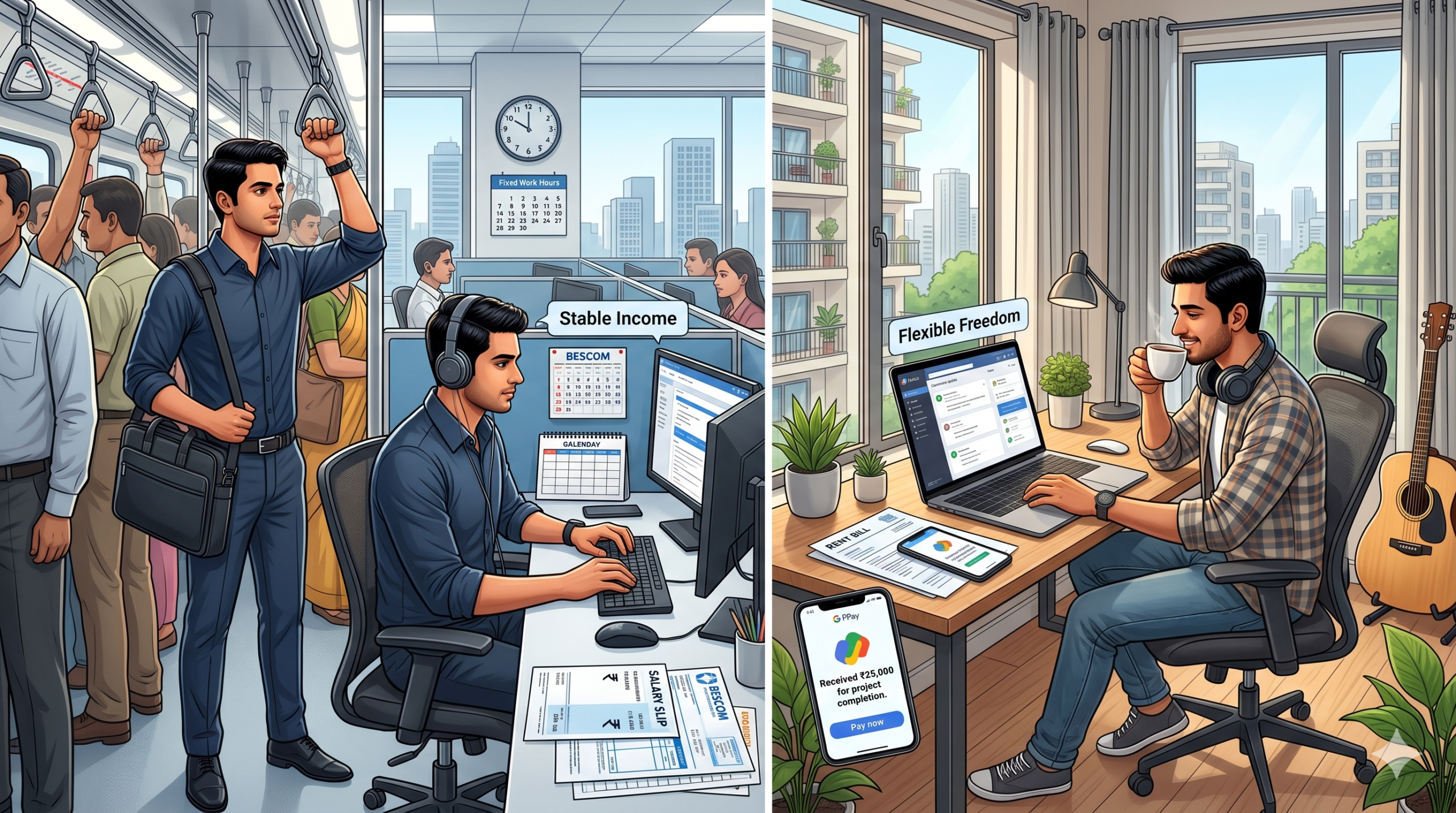
Many Indians feel stuck between two choices.
Take a stable job or try freelancing for more freedom?
One gives fixed income. The other gives flexibility and higher earning potential. But both have risks.
The truth is simple. Neither is automatically better.
Your financial situation, skills, family responsibilities, and risk tolerance matter more.
In this guide, you’ll learn the real difference between freelancing vs job in India, who should choose what, income reality, common mistakes, and how to decide properly.
Quick Answer: Freelancing vs Job in India
- Choose a job if you need stable monthly income
- Choose freelancing if you have marketable digital skills
- Jobs are safer for beginners with financial responsibilities
- Freelancing can earn more, but income is inconsistent
- Many Indians now combine both for extra income
What Is Freelancing and What Is a Job?
What Is Freelancing?
Freelancing means working independently for clients instead of one employer.
You get paid per project, hourly, or monthly contract.
Common freelance skills in India:
- Graphic design
- Video editing
- Content writing
- Coding
- SEO
- Social media management
- UI/UX design
Popular platforms include:
What Is a Job?
A job means working for one company with a fixed salary.
You usually get:
- Monthly salary
- PF
- Insurance
- Paid leave
- Predictable work schedule
Examples:
- IT employee
- Bank staff
- Sales executive
- Government employee
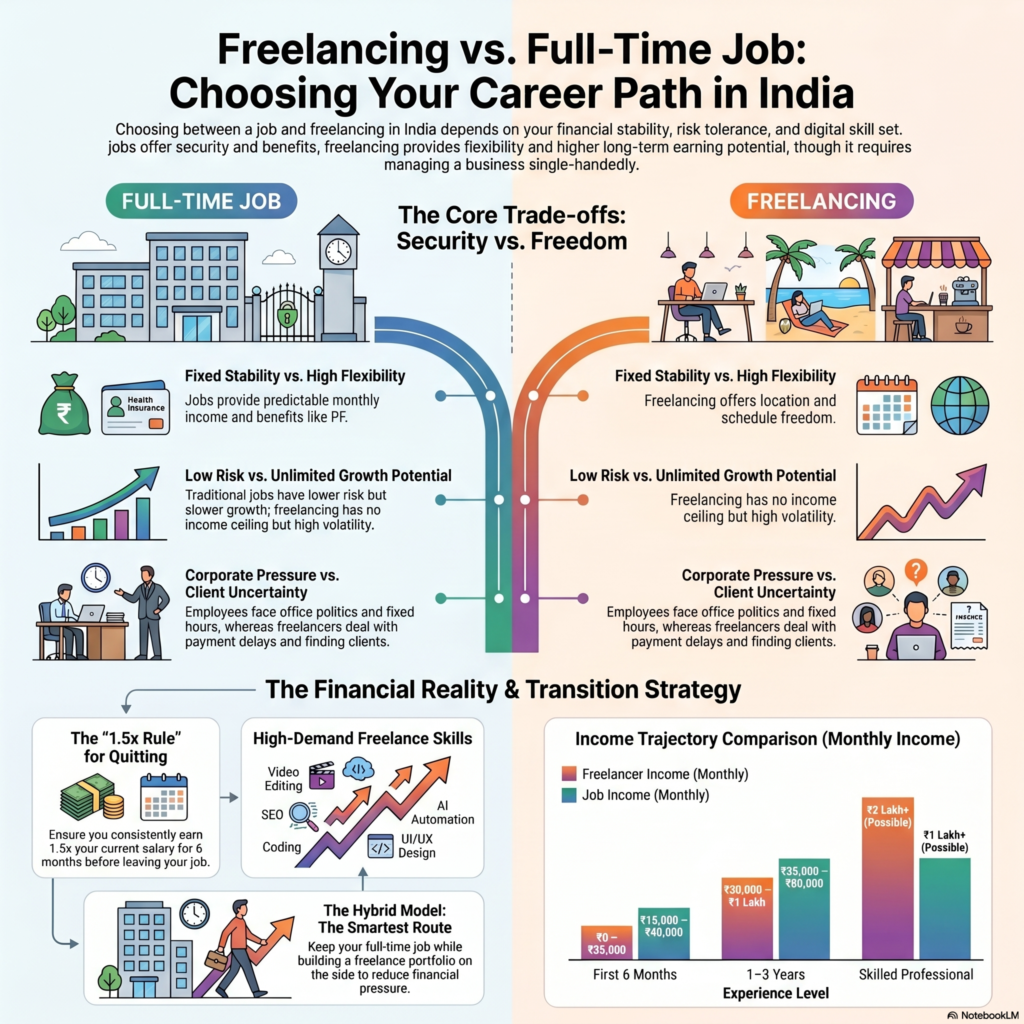
Freelancing vs Job in India: Key Differences
| Factor | Freelancing | Job |
| Income | Unstable initially | Fixed monthly salary |
| Freedom | High | Limited |
| Work Hours | Flexible | Fixed |
| Risk | Higher | Lower |
| Growth | Unlimited potential | Slower but stable |
| Benefits | No PF or paid leave | PF, insurance, leave |
| Stress Type | Client uncertainty | Office pressure |
| Skill Requirement | High | Moderate |
| Job Security | Low | Better |
| Location Freedom | Work from anywhere | Office dependent |
Freelancing vs Job Salary in India
This is where many people become unrealistic.
Social media shows freelancers earning ₹5 lakh monthly.
Most beginners do not.
Here’s the reality.
Average Beginner Income
| Experience | Freelancer | Job |
| First 6 months | ₹0–₹25,000 | ₹15,000–₹40,000 |
| 1–3 years | ₹30,000–₹1 lakh | ₹35,000–₹80,000 |
| Skilled professionals | ₹2 lakh+ possible | ₹1 lakh+ possible |
Freelancing has higher upside.
But income volatility is brutal in the beginning.
A salaried employee at least knows money is coming monthly.
Who Should Choose a Job?
A job is usually better if:
- You support family financially
- You have loans or EMIs
- You lack digital skills
- You prefer stability
- You cannot handle inconsistent income
- You are starting your career
Pros of a Job
- Stable salary
- Easier loan approval
- PF and insurance
- Less financial uncertainty
- Structured career path
Cons of a Job
- Salary growth can be slow
- Office politics
- Limited freedom
- Fixed timings
- Dependence on employer
Who Should Choose Freelancing?
Freelancing makes sense if:
- You already have monetizable skills
- You want location freedom
- You can handle uncertainty
- You are disciplined
- You want higher long-term earning potential
Pros of Freelancing
- Flexible work schedule
- No income ceiling
- Work from home
- Multiple income sources
- Global clients pay in dollars
Cons of Freelancing
- No guaranteed income
- No employee benefits
- Clients may disappear
- Hard to scale alone
- Payment delays happen
Best Option for Most Indians: Hybrid Model
This is the smartest route for many people.
Keep your job.
Start freelancing part-time.
Why?
Because quitting early creates financial pressure.
Pressure destroys decision-making.
A stable salary gives breathing room while building freelance clients.
This is how many successful freelancers started.
Real-Life Indian Example
Scenario 1: Salaried Employee
Rahul works in Chennai as a software tester.
Monthly Income
- Salary: ₹42,000
Monthly Expenses
- Rent: ₹10,000
- Groceries: ₹6,000
- Bike EMI: ₹4,500
- Family support: ₹8,000
- Internet + mobile: ₹1,500
- SIP investment: ₹3,000
- Miscellaneous: ₹5,000
Savings Left
Around ₹4,000
Rahul has predictable cash flow.
But income growth is limited.
Scenario 2: Freelancer
Arun is a freelance video editor.
Monthly Income
- Client 1: ₹25,000
- Client 2: ₹18,000
- Random projects: ₹12,000
Total Income
Around ₹55,000
But next month may be ₹20,000.
Or ₹80,000.
Expenses
Almost same as Rahul.
Difference?
Income uncertainty.
That uncertainty mentally affects many people more than expected.
Freelancing vs Job in India for Freshers
Freshers usually romanticize freelancing.
That’s a mistake.
Without skills, portfolio, or client communication ability, freelancing becomes frustrating quickly.
For most freshers:
- Take a stable job first
- Learn valuable digital skills
- Build freelance income slowly
- Quit only after consistent earnings
A safer target:
Earn at least 1.5x your salary consistently for 6 months before quitting.
Best Freelance Skills in India Right Now
Demand matters more than passion initially.
High-demand freelance skills:
- Video editing
- SEO
- Copywriting
- Web development
- Performance marketing
- Thumbnail design
- AI automation
- UI/UX design
Businesses pay for skills that increase revenue.
Not hobbies.
Common Mistakes People Make
1. Quitting Job Too Early
This destroys savings fast.
Freelancing income takes time.
2. Learning Low-Income Skills
Some skills are overcrowded and underpaid.
Focus on business-related skills.
3. Depending on One Client
One client leaving should not destroy your income.
4. Ignoring Savings
Freelancers especially need emergency funds.
At least 6 months expenses.
5. Not Paying Taxes Properly
Many freelancers ignore GST and income tax.
Later penalties become painful.
You may eventually need:
Pro Tips Before Choosing Freelancing or Job
- Build one strong skill first
- Don’t quit emotionally after workplace frustration
- Save aggressively before freelancing full-time
- Learn sales and communication
- Keep upgrading skills every year
The market punishes outdated skills quickly.
Useful Platforms and Tools
For Freelancers
- Canva for design work
- Notion for client management
- PayPal India for international payments
- Wise for lower forex fees
For Salaried Employees
Freelancing vs Job in India: Which Is Better Financially?
Short-term?
Jobs usually win.
Long-term?
Freelancing can outperform jobs financially if you become highly skilled.
But most people underestimate the difficulty.
Freelancing is not easy money.
You are handling:
- Sales
- Client management
- Delivery
- Negotiation
- Marketing
- Taxes
A freelancer is basically running a small business.
That changes everything.
FAQ
Is freelancing better than a job in India?
Depends on your situation. Jobs offer stability. Freelancing offers higher income potential and freedom.
Can freelancers earn more than salaried employees?
Yes. Skilled freelancers can earn significantly more. But income consistency is harder.
Is freelancing safe in India?
It can work well if you have strong skills, savings, and multiple clients.
Which freelance skill pays most in India?
High-income skills include coding, AI automation, copywriting, and performance marketing.
Should I quit my job for freelancing?
Not immediately. Build stable freelance income first.
Do freelancers pay tax in India?
Yes. Freelancers must pay income tax. GST may also apply depending on turnover and services.
Conclusion
The freelancing vs job debate is not about freedom versus slavery.
That’s internet nonsense.
The real question is this:
What can your current financial situation handle?
If you need stability, choose a job and build skills slowly.
If you already have strong skills and savings, freelancing can create far higher income potential.
For most Indians, the smartest path is simple:
Keep your job.
Build freelance income on the side.
Then switch only when numbers make sense.